 OvercomeMedia
HVAC SEO is the work that gets an HVAC company in front of a homeowner the moment the furnace quits. It has two halves: the Maps 3 pack and the website results. Fix the profile and the pages, and the first results usually show inside 60 to 90 days.
Key points
- Homeowners search “ac repair near me”, “furnace repair [town]” or “hvac [town]” and call the first company that looks real.
- The Maps 3 pack runs on your Google Business Profile, your categories and your reviews.
- The website results run on whether you have a page for the service and the town being searched.
- Most HVAC companies lose on both halves.
- The profile usually runs on one category.
- The website usually has no page for a third of the searches it already shows up for.
We run SEO for HVAC companies. Every number in this guide comes from those accounts or from Google’s own documentation. It is the same checklist we work through on day one of a new heating and cooling account.
In this guide
- What HVAC SEO actually means
- What people actually search for
- Why most HVAC companies do not show up
- What to fix first, in order
- Seasonality: why timing matters more in HVAC
- Cost and timeline
- Frequently asked questions
What does HVAC SEO actually mean?
When a homeowner searches for heating or air conditioning help, Google shows two things on one screen. The map with three businesses, and under it the list of websites.
An HVAC company can win one, both or neither. They are ranked on different signals.
Google says local results are based on relevance, distance and prominence:
- Relevance is “how well a Business Profile matches what someone is searching for”.
- Distance is “how far each business is from the customer who’s searching”.
- Prominence is “how well-known a business is”. Google says this is based partly on “how many websites link to your business and how many reviews you have” (Google Business Profile Help).
For an HVAC company, relevance is the half that gets missed. A profile with the single category “HVAC contractor” is relevant to “hvac near me”. It is much less relevant to “ac repair”, “furnace repair” or “heat pump installation”. That is what people type when something is actually broken.
The website works the same way. Google ranks pages. If there is no heat pump page, there is nothing to rank for heat pump searches.
So HVAC SEO is four jobs. In this order:
- A Business Profile with every category you earn.
- A page for every system and service you sell.
- A page for every town you drive to.
- A steady flow of reviews.
What do people actually search for when they need HVAC help?
Owners tend to guess at this. The guess is usually wrong in a specific way. It underestimates how many searches are for individual systems rather than for “HVAC”.
Here is what Search Console showed for one HVAC client over three weeks in late summer 2026, grouped by the service the searcher typed.
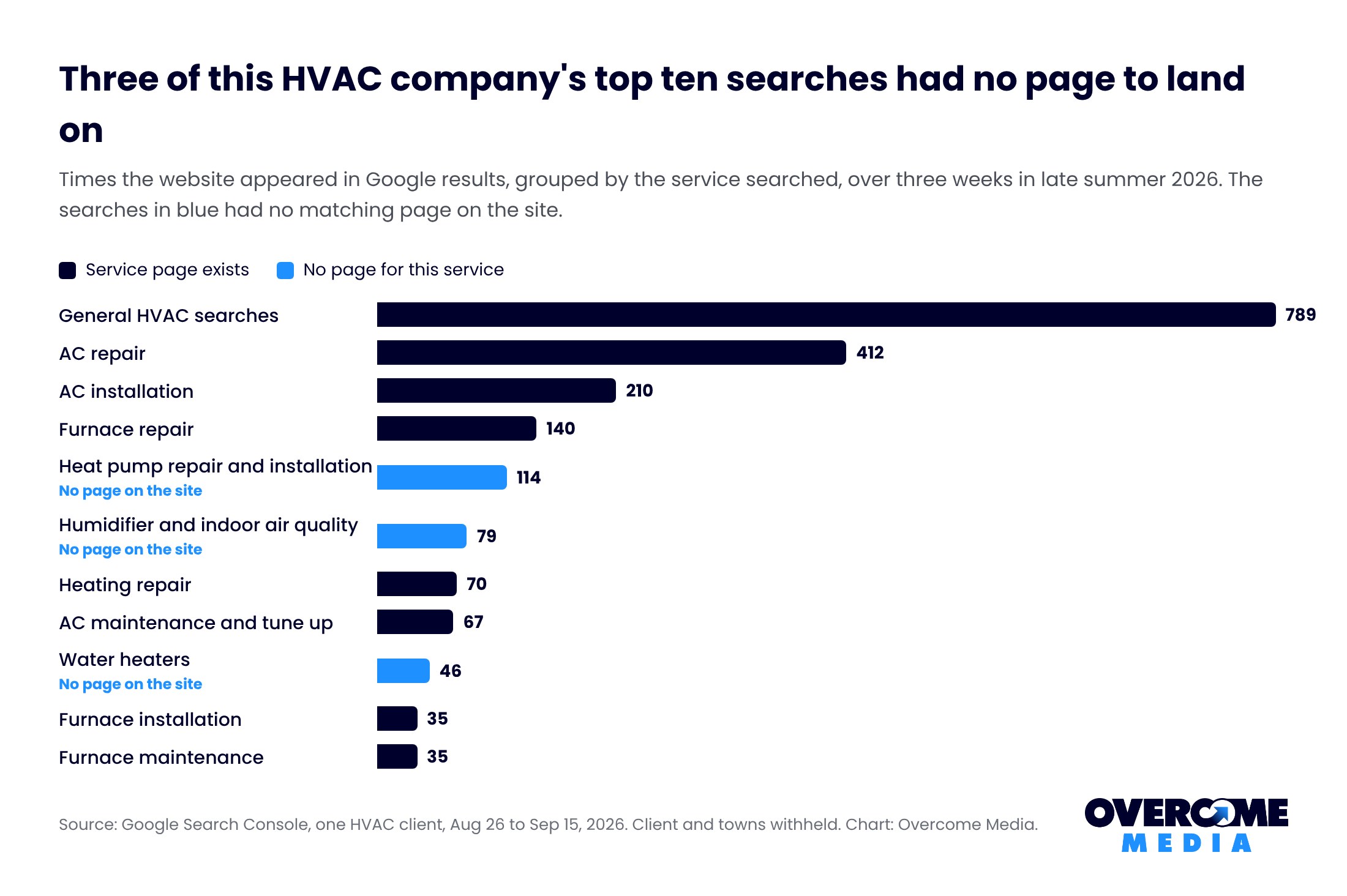
Two things stand out. First, AC repair alone drew more than half as many searches as every general HVAC term combined. That is in a shoulder season.
Second, three of the top ten services had no page on the website at all:
- Heat pumps.
- Humidifiers and indoor air quality.
- Water heaters.
Google was showing the site for those searches anyway, at positions 33 to 42, because nothing better matched. A page for each would have been the cheapest ranking gain on the account.
Phrasing matters too. On the same account:
- “ac repair” out drew “air conditioning repair”.
- “heating repair” out drew “furnace repair” on its own.
- “furnace repair” was the phrase people used when they added a town name.
- “hvac tune up” beat “seasonal maintenance”, which is trade vocabulary that homeowners do not use.
The pages were retitled to match.
A warning about keyword tools. On that account, “furnace repair [town]” had seven real appearances in Search Console and “ac repair [town]” had four. A leading keyword tool reported no data for either.
A tool’s zero on a small town term is a measurement limit, not proof that nobody searches it. Your own Search Console is the better source once the site has a few weeks of data.
Want this done for you? Book a free 15 minute call or call (859) 710-8408. We will tell you what to fix first, no pitch.
Why do most HVAC companies not show up?
In our audits of heating and cooling websites and profiles, the same problems come up almost every time.
- One category on the Business Profile. Primary category HVAC contractor and nothing else. Google allows up to nine secondary categories. Each one is a set of searches the profile can appear for. On one account we took over, the profile had held second place on its city map for “hvac” with a single category and 24 reviews. The four competitors around it carried five to ten categories and 87 to 1,700 reviews. That is a position with no moat. It slipped the first time competitors pushed.
- No page for the systems people search. Heat pumps, mini splits, indoor air quality and water heaters are regularly missing. That happens even when the company installs them every week.
- The busiest town pages are the thinnest. A town page written as three paragraphs of boilerplate with the town name swapped in will rank in the 40s. The towns with the most demand are exactly where that shows.
- The business name is different on every platform. “Ltd. Co.” on Google, “and” instead of “&” on the website, all caps on Yelp. Address and phone usually match. The name usually does not. Google cross references these.
- Reviews stop. Five stars from 24 reviews looks fine until you notice the last one was months ago. On the account above, zero reviews were added in 16 days while one competitor added hundreds.
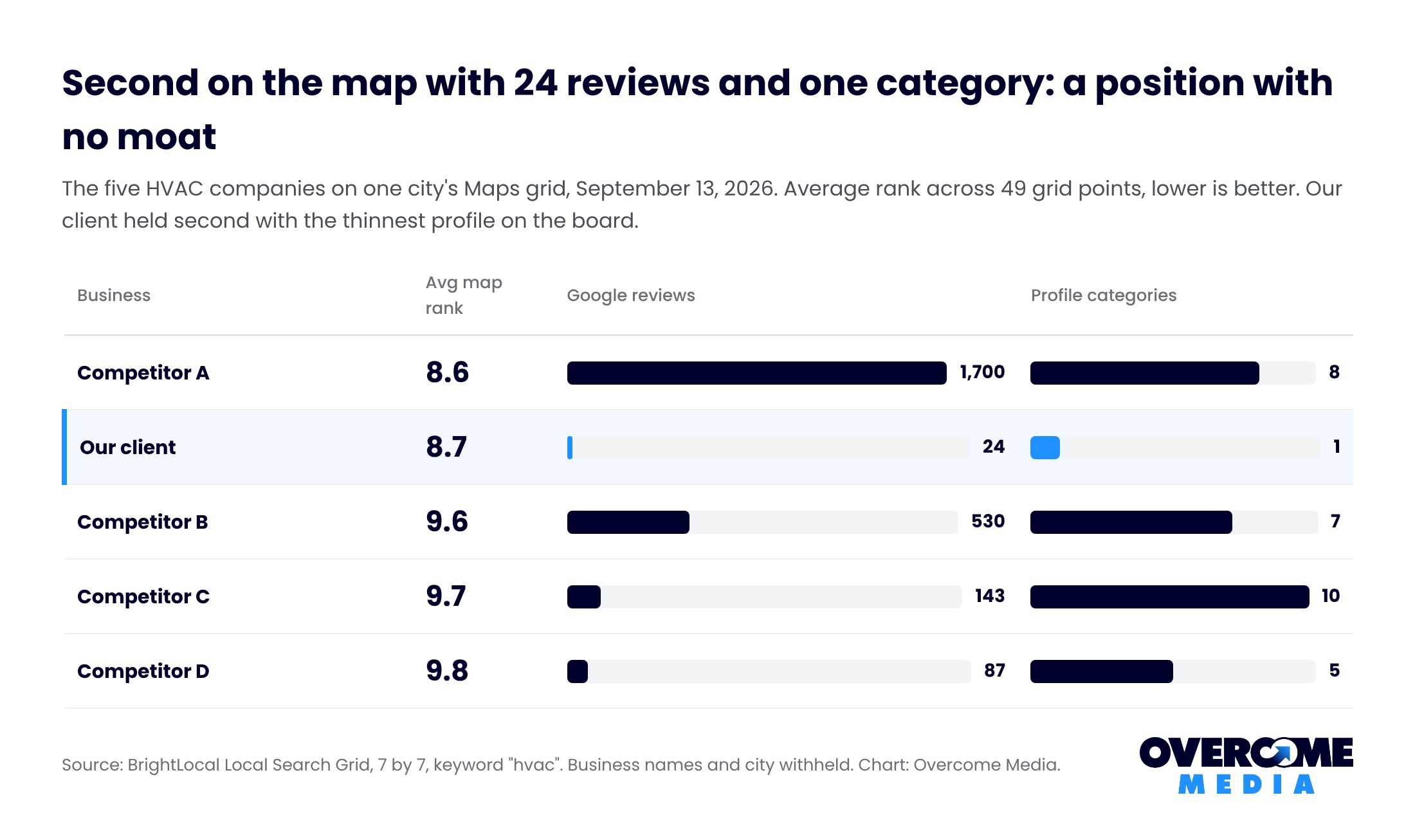
None of these are about the quality of the work. They are about whether Google can tell what the company does and where, and whether it has reasons to trust it.
What should an HVAC company fix first?
In order of return on effort.
1. Add every Business Profile category you earn
Primary category HVAC contractor. Secondary categories for what you actually do:
- Air conditioning contractor.
- Heating contractor.
- Air conditioning repair service.
- Furnace repair service.
- Heating equipment supplier, if you sell and install systems.
Leave off anything you do not sell. One owner we work with does not do duct cleaning and does not want the calls, so that category stays off.
This is free and takes ten minutes. On most accounts it is the single largest untouched lever.
While you are in there:
- Fill the services list, and remove duplicates like two “Thermostat installation” entries.
- Write a description that names your towns and what makes you different.
- Answer the empty Q&A.
- Replace the cropped logo with a photo of a technician at a unit.
Google’s guidance is plain: “Businesses with complete and accurate info are more likely to show up in local search results.”
2. Build a page for every system and service
AC repair, AC installation, furnace repair, furnace installation, heat pumps, maintenance plans, indoor air quality, and whatever else you install. One page each.
Each page needs:
- A title that says the service and your main city (“Heat Pump Installation and Repair in [City], [State]”).
- What you do.
- What it typically costs or how pricing works.
- Photos of your own jobs.
The chart above is the argument. The searches already exist, and Google is already showing your site for them at position 40. A real page moves that.
3. Rebuild the town pages that carry the demand
Pull the Search Console page report and sort town pages by impressions. The towns at the top are where the calls are.
On the account below, the two biggest towns drew 561 and 207 appearances. They sat at positions 43 and 44. A town with no page at all drew 81 and ranked better than both.
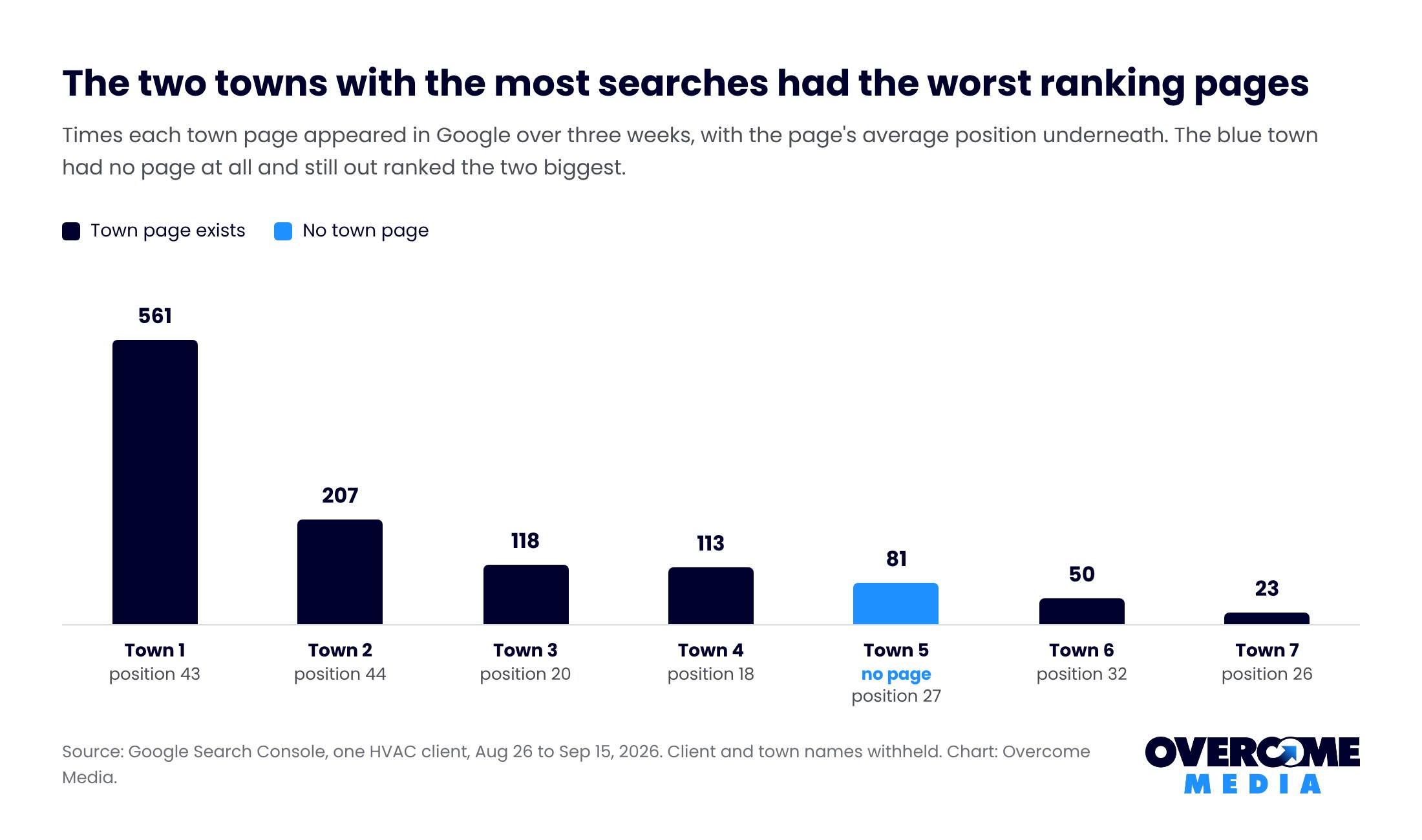
Rebuild those two first, with copy that is actually about the town:
- The neighborhoods you work in.
- The age of the housing stock and what that means for the systems in it.
- Drive time from your shop.
- Jobs you have done there.
Then build the page for the town that has demand and no page. Do not list 30 towns in a footer and call it coverage. Google ranks pages, not lists.
4. Make the name match everywhere
Pick one form of the business name. Use it on the Business Profile, the website, Yelp, Facebook, the BBB and every directory. Same for the address wording.
On most HVAC accounts we audit, the company is listed in only two or three of the forty odd directories Google checks. That is a slow, cheap fix worth doing in the first quarter.
5. Get a review from every finished job
HVAC has an advantage most trades do not. A technician is standing in the customer’s home at the moment the problem is fixed. That is the ask.
A text with the review link sent from the truck before pulling away converts far better than an email two days later. Target one review per completed job.
Google states that “more reviews and positive ratings can help your business’s local ranking”. Reply to every one, including the bad ones.
6. Earn links from local websites
Where the links come from:
- Your equipment distributor’s dealer locator.
- The chamber of commerce.
- The home builders association.
- The high school booster club.
- The local news story about the family you helped in a heat wave.
Links are the slowest lever, which is why they come last. But prominence does not move without them.
Why does timing matter more in HVAC SEO than in other trades?
Because demand swings twice a year, and Google takes weeks to notice a new page. AC repair searches peak in the first hot week of summer. Furnace repair searches peak in the first cold snap.
A page published the day the heat arrives will not be ranking until the rush is half over.
The practical rule: have the cooling pages finished and indexed by March, and the heating pages by September. Use the off season for the slow work: categories, citations, links and town pages. Then the profile and the site are at full strength when the phones start.
Maintenance plan pages are the exception. They are searched in the shoulder months, when a tune up is on the homeowner’s mind. They should be live year round.
How much does HVAC SEO cost and how long does it take?
Most HVAC companies that hire an agency pay between $2,000 and $6,000 a month for local SEO, as of October 2026. The range depends on how many towns and services are in scope, and whether the website needs rebuilding.
Doing it in house costs a few hours a week and the discipline to ask for reviews on every job.
On timing: category and profile fixes show in the Maps grid within one to two months. New service and town pages take four to eight weeks to settle into a position. Reviews and links compound over quarters.
We tell owners to judge the program at month six and again at month nine. Look at the season to season comparison, not month to month. A May to June jump in AC searches is weather, not SEO.
The website itself needs:
- A page per service.
- A page per town.
- A phone number in the header that matches the Business Profile.
- Real job photos.
- A short form for people who will not call at 11 pm.
The website design page covers how we build those.
Frequently asked questions
How long does HVAC SEO take to work?
Profile and category fixes can move the Maps results inside one to two months. New service and town pages take four to eight weeks to settle. Judge the whole program at six to nine months, comparing the same season year over year.
Which Google Business Profile categories should an HVAC company use?
HVAC contractor as the primary. Then secondaries for the services actually sold: Air conditioning contractor, Heating contractor, Air conditioning repair service, Furnace repair service, and Heating equipment supplier if you sell systems. Skip categories for services you do not want calls for.
Does an HVAC company need a separate page for each service?
Yes. Google ranks pages, and “heat pump repair” and “ac installation” are different searches with different intent.
On one account, three of the ten most searched services had no page. The site ranked in the 30s and 40s for all of them.
How many Google reviews does an HVAC company need?
Fewer than the competitors’ totals suggest, but more per month than they are adding. The practical target is one review per completed job, asked for by the technician before leaving the house.
A company doing 60 jobs a month that collects even a third of those will be the fastest growing profile on most city maps.
Is Google Business Profile more important than the website for HVAC companies?
For emergency searches, yes. “AC repair near me” at 9 pm is answered from the map, and the call comes from the profile.
The website matters for planned work, installations, maintenance plans and town searches. It also turns a visitor into a booked job.
Want to know where your HVAC company stands?
We will run the HVAC checks above on your profile and your site, categories and missing pages included. We send back what we find, with the three things to fix first. No call required. Request the free SEO audit or call (859) 710-8408.
Overcome Media is a marketing agency in Lexington, Kentucky. We work with heating and cooling companies across Kentucky, Ohio and the surrounding states. See what we do for HVAC companies, or read the companion guide to roofing SEO.
Sources
- How to improve your local ranking on Google, Google Business Profile Help
- Google Search Console and BrightLocal Local Search Grid data from an Overcome Media HVAC client, August 26 to September 15, 2026. Client and towns withheld.

Written by
Faisal Zaman
Senior SEO Strategist, Overcome Media
Faisal runs SEO for Overcome Media’s roofing, HVAC, junk removal and dumpster rental clients. He builds the Google Business Profile, location page and content plans that get blue collar companies into the map pack, and writes the Knowledge Base from what works on live client accounts.