 OvercomeMedia
Truck wrap cost in 2026 runs about $2,500 to $5,000 for a full wrap on a pickup or cargo van. A box truck runs $4,000 to $8,000. Wraps bring leads indirectly, through recognition, not through calls to the number on the door.
Key points
- A partial wrap costs $1,000 to $2,500, and vinyl lettering with a logo $250 to $1,000.
- Cast vinyl lasts five to seven years, so even a full wrap works out to roughly $35 to $70 a month.
- That is less than one day of Google Ads for most contractors.
- Anyone who tells you a wrap “generated 40 calls” is guessing.
- The lead shows up later as a branded Google search, a map click, or a “we see your trucks everywhere” on the first call.
- Measure those three things, put five things on the truck, and leave everything else off.
We design vehicle graphics for trades clients as part of their branding. We see what happens afterwards in their Search Console and their CRM.
The prices below are typical ranges from US wrap and sign shops. Your quote depends on the vehicle, the vinyl and your market.
In this guide
- What truck wraps and lettering cost
- Do truck wraps actually bring leads?
- What to put on the truck
- Lettering, partial or full wrap: which one
- How to tell if it is working
- Mistakes we see on trucks every week
- Frequently asked questions
Truck wrap cost in 2026: wraps, partial wraps and lettering
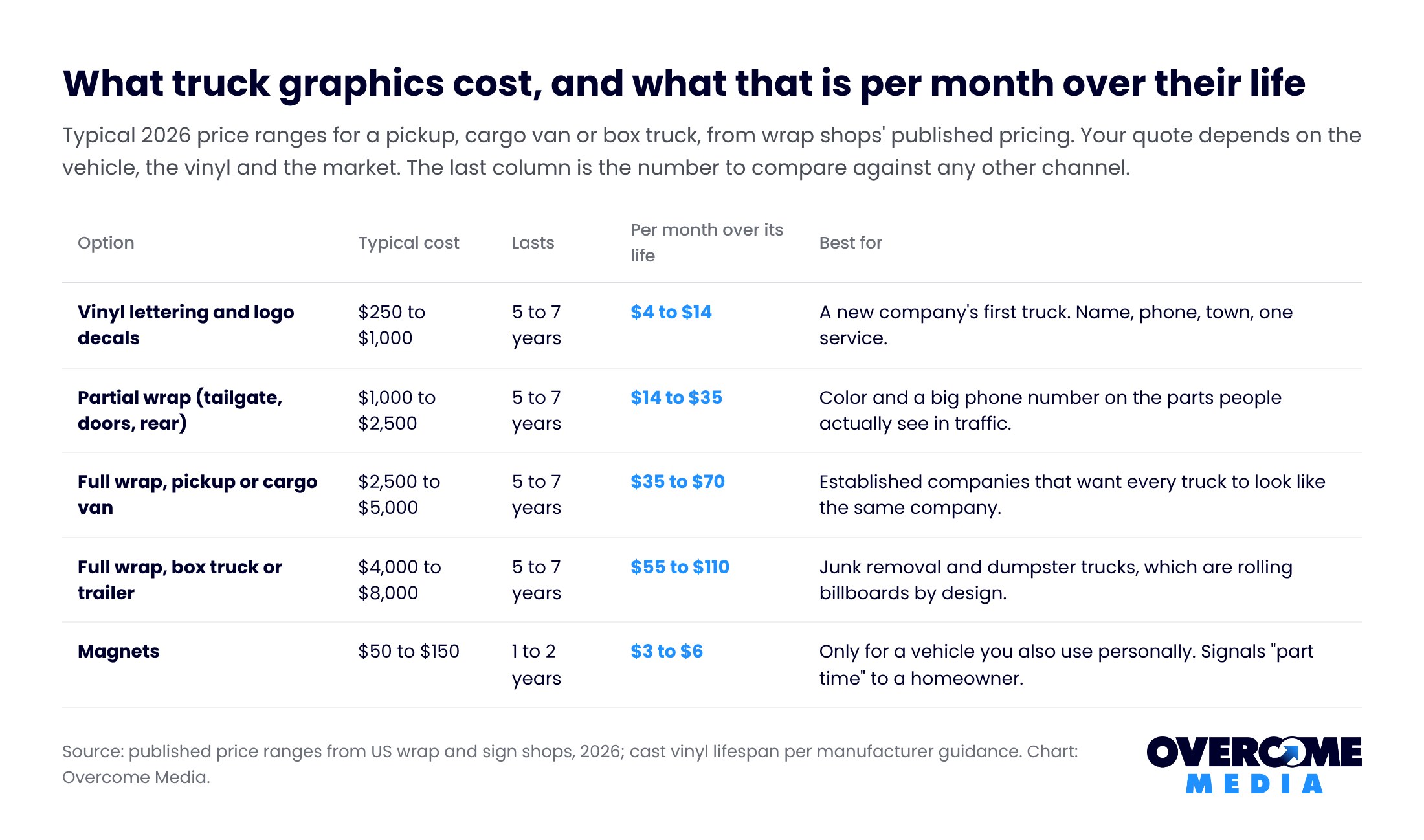
The spread inside each range comes from three things.
- Vehicle size and shape. A box truck has flat sides and goes fast. A pickup with flares and a bed takes longer per square foot.
- Vinyl grade. Cast vinyl from the major manufacturers conforms to curves and lasts five to seven years. Cheaper calendered vinyl is fine for a flat box side and lasts two to three.
- Design. A shop will quote the install. The design is either included, extra, or something you bring. Bring it, so it matches the rest of your branding.
Get the number in your head as cost per month over the life of the wrap, as in the last column. A $4,000 wrap over six years is $55 a month.
That buys every person at every red light reading your name. That is the right comparison against ads, not the invoice.
Do truck wraps actually bring leads?
Indirectly. The honest version of the answer matters because the industry sells it dishonestly.
You will read claims like “a wrapped vehicle gets 30,000 to 70,000 impressions a day”. They trace back to a handful of old studies and a lot of repetition.
The most cited one is a 3M study from 2008. It compared fleet graphics with six other media on cost per thousand impressions. Graphics came out far cheaper than anything else.
That shape is probably still true. The specific numbers are 18 years old.
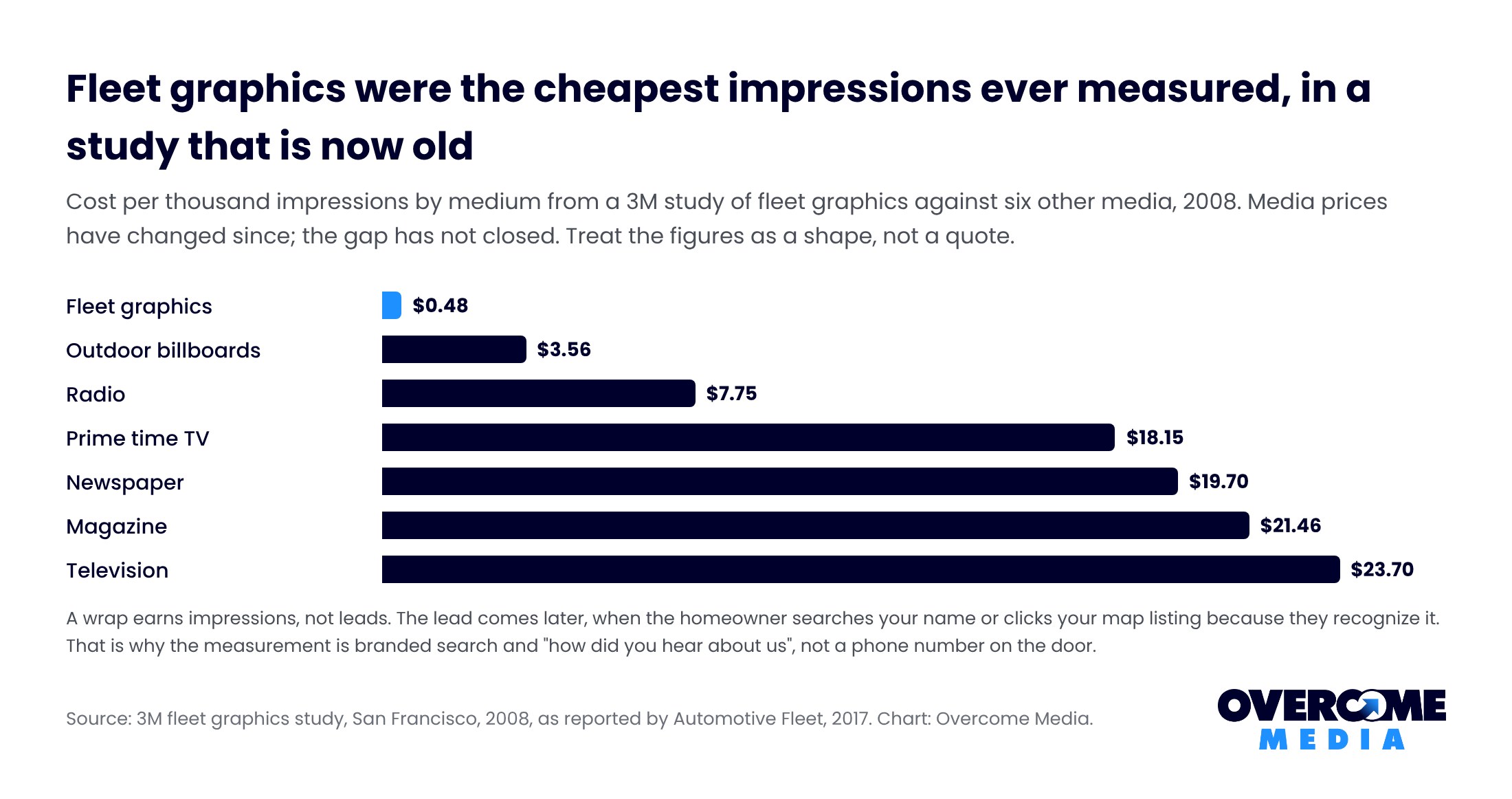
What a wrap actually does is make a homeowner recognize you at the moment they search. They see the truck on their street three times in a month. Then the AC dies and they search “ac repair near me”.
Three names come up on the map, and they recognize one. That is the lead the wrap produced. It shows up in your data as a map click or a branded search, not as a call to the number on the door.
On the accounts we run, branded searches (people typing the company name) are a steady share of all searches. They rise after a fleet gets wrapped and after yard signs go out.
We cannot split that between trucks and signs. Neither can anyone else.
So: wraps bring leads the way a good reputation brings leads. Slowly, through other channels, and more every year the trucks are on the road.
They do not replace the Business Profile, the website or ads. They make all three convert better.
Want this done for you? Book a free 15 minute call or call (859) 710-8408. We will tell you what to fix first, no pitch.
What should a work truck actually say?
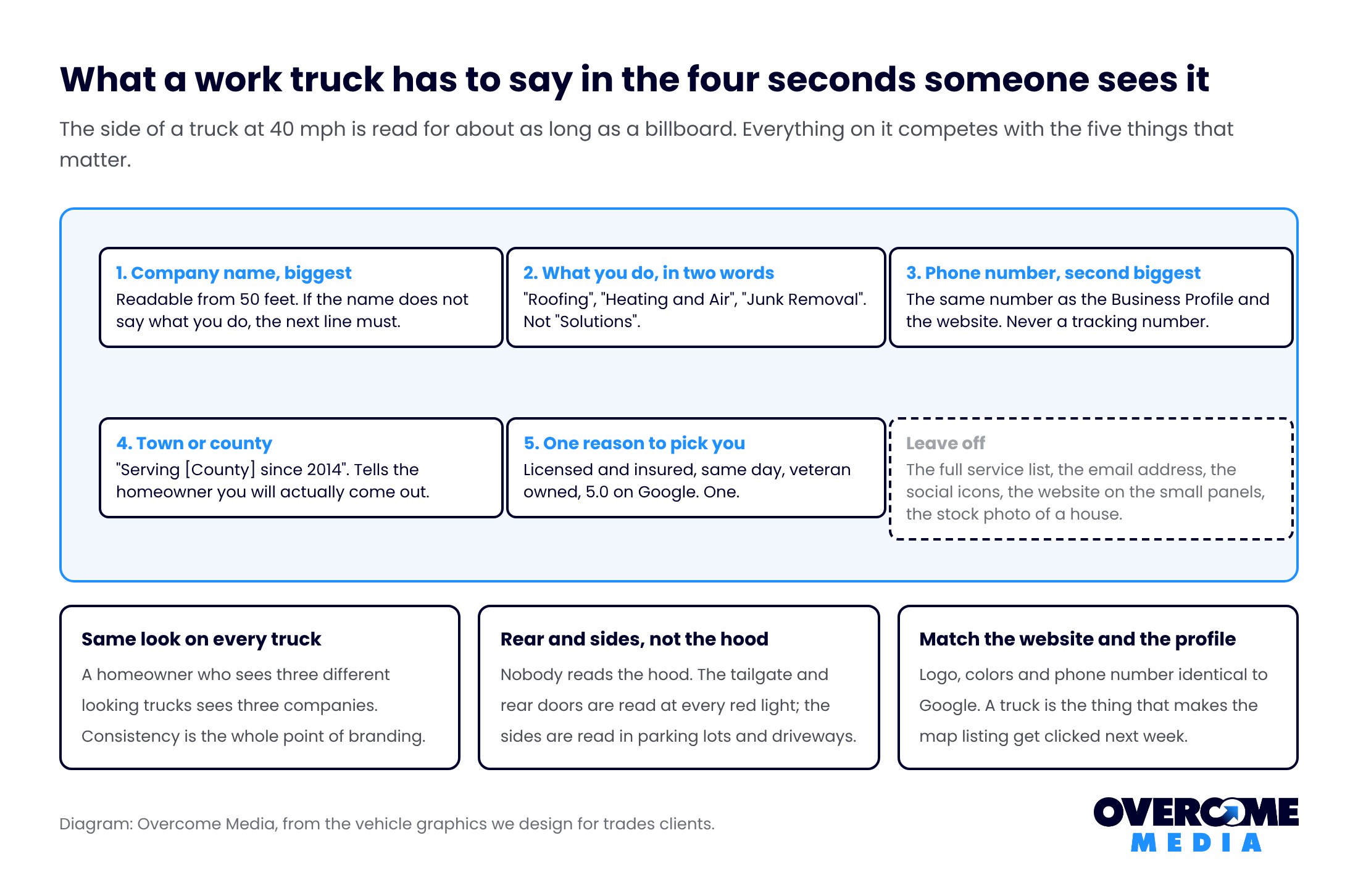
Five things, and the order matters.
- The company name, biggest.
- What you do, in two words, unless the name already says it.
- The phone number, second biggest. It must be the same number that is on your Google Business Profile and your website. Never put a tracking number on a truck. It breaks your listing consistency, and the number lives for six years.
- The town or county you serve, so a homeowner knows you will come out.
- One reason to pick you: licensed and insured, same day, veteran owned, 5.0 on Google. One, not five.
Everything else comes off.
- The full service list nobody can read at 40 mph.
- The email address.
- Social media icons.
- The website on panels too small to read. Put it once, on the tailgate, if at all.
- Stock photos of houses.
- The hood, which nobody reads.
The rear doors and tailgate get read at every red light. The sides get read in driveways and parking lots. Design for those two views.
And the one that matters most: every truck looks the same. A homeowner who sees three different looking trucks from the same company sees three companies.
Same logo, same colors, same number, matching the website and the profile exactly. Consistency is the whole point of branding.
It is the part owners skip. Usually the second truck was bought used and lettered by a different shop.
Lettering, partial wrap or full wrap: which should a contractor choose?
- First truck, new company, tight cash: lettering and a logo, $250 to $1,000. Done right, with the five things above in the right sizes, it looks like a real company. Skip magnets unless the vehicle is also the family car. Magnets read as part time.
- Established company, white or single color trucks: a partial wrap, $1,000 to $2,500. Color on the rear and lower sides, the name and number big, the factory paint doing the rest. Most of the recognition of a full wrap at a third of the cost.
- Fleet of three or more, or a box truck or trailer: full wrap, $2,500 to $8,000 depending on the vehicle. A junk removal or dumpster truck is a rolling billboard by its nature. The whole side is readable from a block away and it sits in driveways for hours. That is the one case where full coverage pays for itself fastest.
Whatever the option, do the design before the shop quotes it. Do it as part of the brand, so the truck, the yard sign, the website and the Business Profile cover photo are one thing. The branding page covers how we do that.
How do you tell if a truck wrap is working?
- Branded searches in Google Search Console. Filter queries to your company name and watch the monthly count. It should climb in the months after the trucks go out and keep climbing as the fleet grows.
- Map listing clicks and calls. In the Business Profile performance report, and with a tagged link in the profile so map clicks are separated in analytics. Recognition shows up here as more people picking you out of the three.
- “How did you hear about us”, asked on every call and logged in the CRM. “Saw your truck” is the only direct measurement that exists. Make the office write it down.
- Not a tracking number on the truck. It costs you listing consistency for a number that will be dialed a few times a year. A QR code on the tailgate that goes to a tagged page is a harmless alternative if you want one more signal.
What mistakes do we see on trucks every week?
- A name that does not say the trade, with no second line that does.
- A phone number that does not match the Business Profile, usually because the owner’s cell went on the truck and the office line went on Google.
- Ten services in a list, in a font readable from four feet.
- Three trucks, three looks, three shops.
- A dirty truck. A wrap on a truck that is never washed advertises that.
- A great wrap and no reviews. The homeowner recognized you, searched, saw 6 reviews against a competitor’s 300, and called them. The truck did its job. The profile lost the lead.
Frequently asked questions
How much does it cost to wrap a work truck?
Truck wrap cost is about $2,500 to $5,000 for a full wrap on a pickup or cargo van in 2026. A box truck runs $4,000 to $8,000, depending on size, vinyl and market. Partial wraps run $1,000 to $2,500 and lettering with a logo $250 to $1,000.
How long does a truck wrap last?
Five to seven years for cast vinyl installed well and washed regularly, two to three for calendered vinyl. Sun, pressure washing up close and a truck that is never cleaned all shorten that.
Is truck lettering enough, or do I need a full wrap?
Lettering is enough for a first truck if it carries the five essentials at the right sizes. A full wrap earns its cost on box trucks, trailers and fleets. There the whole side is readable and consistency across vehicles is the point.
Should I put a tracking phone number on my truck?
No. Use the same number as your Google Business Profile and website. Tracking numbers belong on digital sources where they can be swapped.
A truck number lives for six years and a mismatch hurts your map listing. Measure the truck through branded search, map clicks and “how did you hear about us”.
Do truck wraps work for roofing, HVAC and junk removal companies?
Yes, differently. Junk removal and dumpster trucks are the best case: big flat sides, parked in driveways for hours, seen by every neighbor. HVAC vans sit in driveways across the service area all day.
Roofing trucks are seen at the job site. That is why the yard sign matters as much as the truck for roofers.
Want the truck, the signs, the site and the profile to look like one company?
We design the whole set together so every piece reinforces the others. See the branding service, or request the free audit or call (859) 710-8408. We will tell you whether your profile is ready to catch the recognition a wrap will create.
Overcome Media is a marketing agency in Lexington, Kentucky. We handle branding, websites, SEO and ads for roofing, HVAC, junk removal and other trades businesses across Kentucky, Ohio and the surrounding states. Related: call tracking for contractors.
Sources
- Published price ranges from US vehicle wrap and sign shops, 2026; vinyl manufacturer durability guidance
- 3M fleet graphics cost per thousand impressions study, San Francisco, 2008, as reported by Automotive Fleet (2017)
- Google Search Console and Business Profile data from Overcome Media client accounts, 2026. Clients withheld.

Written by
Faisal Zaman
Senior SEO Strategist, Overcome Media
Faisal runs SEO for Overcome Media’s roofing, HVAC, junk removal and dumpster rental clients. He builds the Google Business Profile, location page and content plans that get blue collar companies into the map pack, and writes the Knowledge Base from what works on live client accounts.