 OvercomeMedia
Junk removal SEO is the work that gets a hauling company in front of a homeowner the moment the couch has to go. It has two halves: the Maps 3 pack and the website results underneath. The fixes below usually show inside 60 to 90 days.
Key points
- Homeowners search “junk removal near me”, “furniture removal [town]” or “estate cleanout” and book the first company that looks real and can come soon.
- The Maps 3 pack runs on your Google Business Profile, its primary category, its hours and its reviews.
- The website results run on whether you have a page for the item being searched and the town it is in.
- Junk removal has a quirk most trades do not: people search by the thing, not the service.
- A site with one “junk removal” page and no furniture, appliance or hot tub pages is invisible for most of the demand.
We run SEO for junk removal companies. Every number in this guide comes from those accounts or from Google’s own documentation. It is the same checklist we work through on day one of a new hauling account.
In this guide
- What junk removal SEO actually means
- The primary category: the biggest single lever
- Why your hours change your map rank
- A page for every item, not one page for “junk”
- Reviews: velocity beats totals
- What to fix first, in order
- Cost and timeline
- Frequently asked questions
What does junk removal SEO actually mean?
When someone searches for a hauler, Google shows two things on one screen. The map with three businesses, and under it the list of websites.
A junk removal company can win one, both or neither. They are ranked on different signals.
Google says local results are based on relevance, distance and prominence:
- Relevance is “how well a Business Profile matches what someone is searching for”.
- Distance is “how far each business is from the customer who’s searching”.
- Prominence is “how well-known a business is”, based partly on “how many websites link to your business and how many reviews you have” (Google Business Profile Help).
Junk removal is unusual. Relevance and distance do most of the work, and both are things you control.
- The primary category decides what searches the profile is relevant to.
- Your listed hours decide whether Google considers you available at the moment of the search.
- Haulers drive to the customer. So the service area and the town pages decide how far from the shop the profile and the site can rank.
Prominence, which is reviews and links, is the slow half. Most junk removal companies lose on the fast half first.
Why is the primary category the biggest single lever in junk removal SEO?
Because Google weights the primary category far more than the secondaries. And junk removal companies are often filed under the wrong one.
Garbage collection service, Waste management service, Debris removal service and Junk dealer all sound close. They are not what the top of the pack uses.
On one junk removal account we took over in September 2026, the profile had seven categories. “Garbage collection service” was the primary. “Junk removal service” was buried as a secondary.
Here is where it ranked on the day we checked, measured live from the shop’s coordinates:
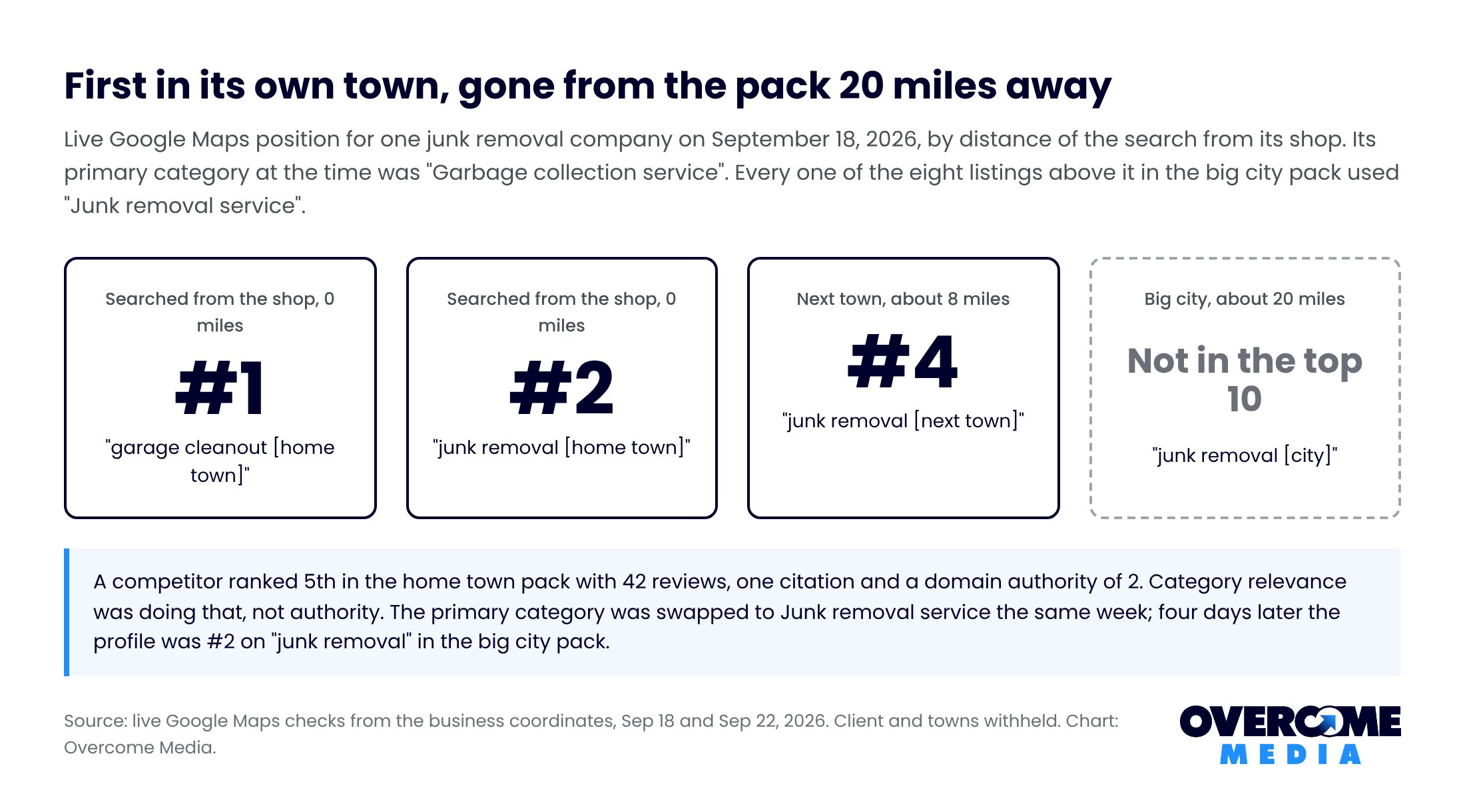
First in its own town. Fourth one town over. Not in the top ten in the big city 20 miles away. Every one of the eight listings above it there used “Junk removal service” as the primary category.
One of those competitors sat fifth in the home town pack with 42 reviews, a single directory listing and a domain authority of 2. That is not prominence. That is relevance.
We swapped the primary to Junk removal service and moved Garbage collection service to a secondary. We changed nothing else on the profile.
Four days later the profile was second on “junk removal” in that big city pack, behind only the national franchise. It was also second on “garage cleanout”. A ten minute edit.
Two cautions from the same account. Google will sometimes display a secondary category instead of the primary on specific searches. Off target secondaries like Junk dealer or Waste management service can dilute the profile on exactly the searches you want. Remove the ones you do not actually serve.
And do not batch a category swap with a dozen other profile edits in the same week. The profile goes through re-evaluation after each change. Stacking them makes any dip harder to read.
Want this done for you? Book a free 15 minute call or call (859) 710-8408. We will tell you what to fix first, no pitch.
Why do your listed hours change your map rank?
This one surprised us. We track map rank on a 49 point grid around each client. One junk removal profile kept collapsing on the weekly report while nothing about it had changed.
When we pulled every run, the pattern was the day of the week.
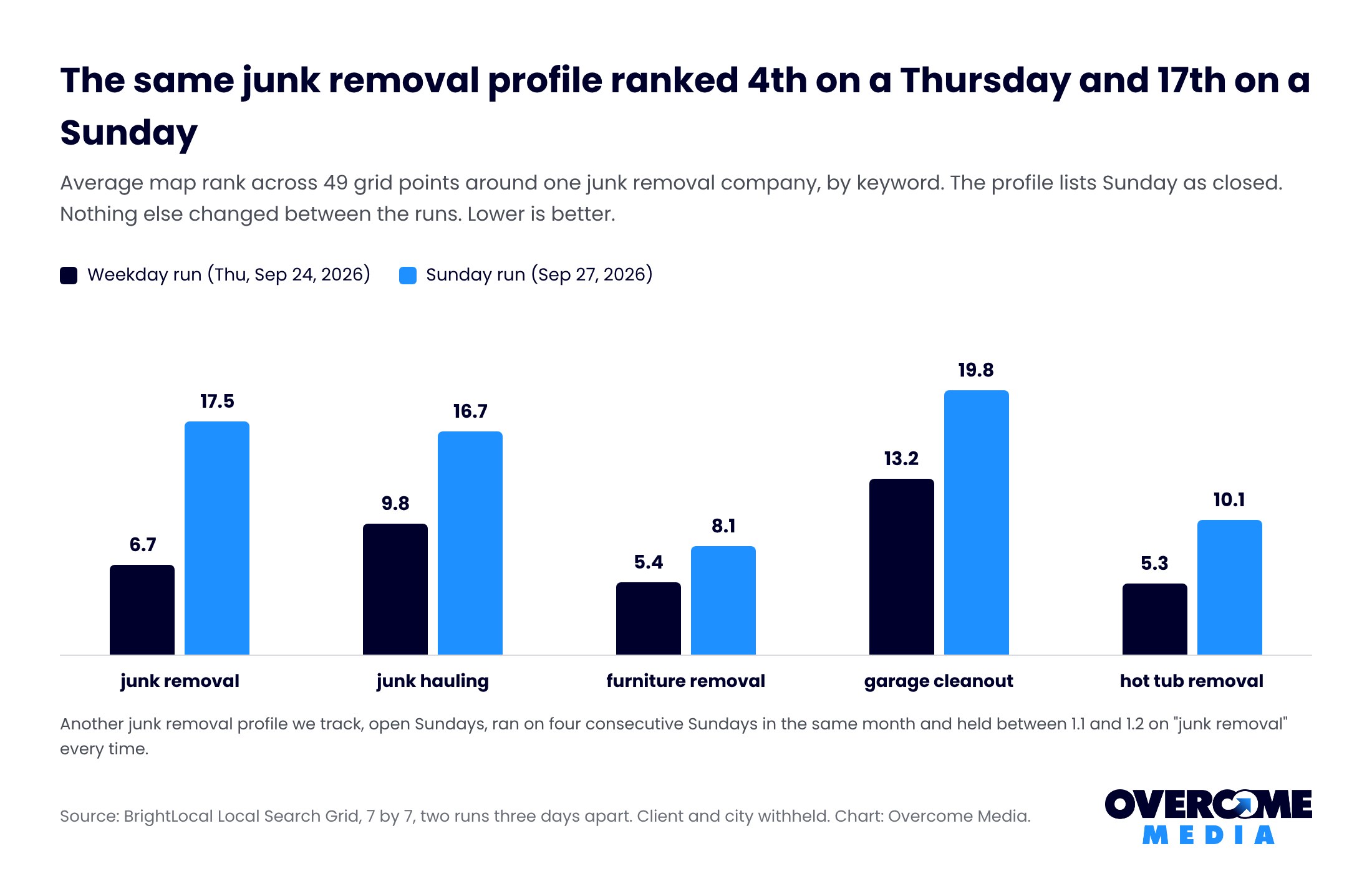
Every weekday run was healthy. Both Sunday runs collapsed to nearly identical numbers.
On the Sunday runs the profile still ranked second or third right at the shop. It was the reach that shrank. It fell to 11th in the inner ring and 20th in the outer ring, against 2.8 and 8.7 on the Thursday.
The profile lists Sunday as closed. Google treats “open at search time” as a ranking factor in the pack. On a closed day it pulls a business’s radius in and fills the three spots with companies that are open.
The control was another junk removal profile we track that lists Sunday hours. It ran on four consecutive Sundays in the same month. It held between 1.1 and 1.2 on “junk removal” every time.
What to do with that: if you actually take calls and bookings on Sunday, list the hours. Weekend demand for junk removal is real, because that is when people clean out garages.
If you do not work Sundays, never list hours you do not keep. Google and your customers will both punish that. But know that a closed day is a day you are mostly out of the pack beyond your own neighborhood.
Check what day your rank reports run on. Otherwise you will spend a month chasing a drop that is not there.
Why does a junk removal site need a page for every item?
Because that is how people search. These are separate searches with separate intent:
- “Hot tub removal”
- “Piano removal”
- “Mattress disposal”
- “Appliance removal”
- “Estate cleanout”
- “Construction debris removal”
Google ranks pages, not businesses. A site with one junk removal page competes for one of them.
On one account, we built ten new pages from nothing: a city page, construction debris, estate cleanouts, dumpster rentals, areas we serve, furniture, a second town, appliances, pianos and hot tubs.
They drew 681 Google appearances in their first four weeks. The city page led at 183, and construction debris at 82.
On the map grid the same company averaged 1.6 on “furniture removal” and 1.6 on “hot tub removal”. It averaged 15.4 on “estate cleanout”, which was the newest page. Pages take a few weeks to settle. The ones that have been up longest rank best.
The failure mode is the opposite: pages that exist but say nothing. On another account, all 16 service pages had been cloned from the furniture removal page. The last two sections were never rewritten. So the hot tub page told the reader about furniture removal twice before it ended.
Eleven of those 16 pages ranked for nothing at all. The homepage carried 44 of the site’s 58 ranked searches on its own.
A page per item only works when each page is actually about the item:
- What you take.
- What you will not take.
- What it typically costs.
- How fast you can come.
- Photos of your own crew doing it.
Town pages follow the same rule. Seventeen cities named in plain text at the bottom of every page is not coverage. One page per town, with real copy, is.
Why does review velocity beat review totals?
Junk removal companies tend to have more reviews than other trades. The job is quick, the customer is home, and the relief of an empty garage is a good moment to ask. That makes it easy to coast on the total.
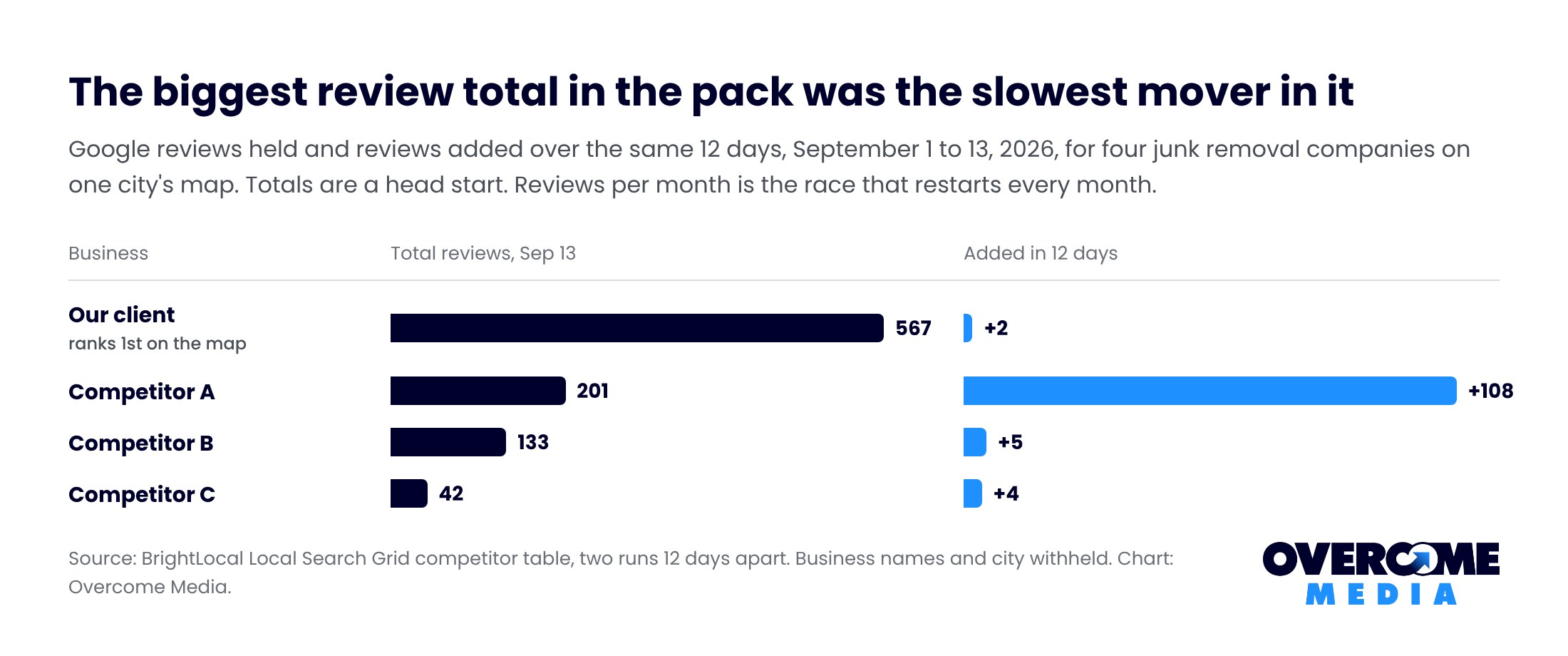
The company at the top of this map held 567 reviews, more than double anyone near it. It added two in twelve days. The competitor with 201 added 108 in the same window.
On totals the leader looks untouchable. On velocity it is the slowest mover in its own pack. Local ranking studies consistently find recent reviews count for more than old ones.
The fix is a routine, not a campaign. The crew lead sends the review link by text from the truck before leaving, every job. One review per completed job is the target.
Reply to all of them. On one profile we audited, 15 new reviews were waiting with no response. The newest reply was four months old.
Read the reviews, too. Google summarizes what customers mention. On one hauling profile the top topics were:
- Reasonable pricing (24 mentions).
- Yard waste removal (9).
- Easy scheduling (8).
- Same day pickup.
None of the four appeared anywhere on the website. Your customers are telling you what to write.
What should a junk removal company fix first?
In order of return on effort.
- Primary category: Junk removal service. Secondaries only for what you sell: Dumpster rental service if you rent them, Debris removal service, House clearance service. Remove Junk dealer and Waste management service unless you are one.
- Hours that are true, and a website link that is clean. One profile we audited linked to the http, www version of its site. Every map click took two redirect hops before landing. Use the https address you actually use, with a tracking tag so you can see map clicks in analytics.
- Photos. A hauling profile with 69 photos was ranking against competitors with 256 to 875. Before and after shots from every job, uploaded weekly from the crew’s phones, close that gap in a quarter.
- One page per item and one page per town, each written about that item or that town. Start with the five items you haul most and the three towns you want more of.
- The review routine, from the truck, every job, with replies.
- Citations and links. One account we audited was listed in 5 of the 38 directories Google checks. That was the lowest of any listing ranking above it. The address was right on only one of the five. Fix the directory listings first. Then earn links from the local charity, the realtor who sends you estate cleanouts and the dumpster company you partner with.
How much does junk removal SEO cost and how long does it take?
Most junk removal companies that hire an agency pay between $2,000 and $6,000 a month for local SEO, as of October 2026. The range depends on how many towns and how many item pages are in scope, and whether the site needs rebuilding.
Doing it in house costs a few hours a week and the discipline to ask for reviews and photos on every job.
On timing: a primary category fix can show in the pack within days, as above. New item and town pages take four to eight weeks to settle. Reviews, photos and links compound over quarters.
Judge the program at month six and again at month nine. Compare weekday to weekday.
The website itself needs:
- A page per item.
- A page per town.
- A phone number in the header that matches the Business Profile.
- Real before and after photos.
- Upfront pricing guidance.
- A short form with a “when do you need it gone” field.
The website design page covers how we build those.
Frequently asked questions
What is the best Google Business Profile category for a junk removal company?
Junk removal service as the primary. On one city map, all eight listings above our client used it as the primary. Swapping to it moved the client from outside the top ten to second within four days.
Garbage collection service and Waste management service describe different businesses.
Should a junk removal company list Sunday hours?
Only if it actually takes calls and bookings on Sunday. If it does, list them. Google favors businesses that are open at the time of the search, and a closed day shrinks the profile’s map reach.
Never list hours you do not keep.
Does a junk removal website need a separate page for each item?
Yes. People search for the item (hot tub, piano, mattress, appliance) rather than for “junk”, and Google ranks pages. Ten item and town pages built from nothing on one account drew 681 Google appearances in their first month.
How many Google reviews does a junk removal company need?
Fewer than the totals on the map suggest, but more per month than the competition is adding. The company at the top of one map with 567 reviews added two in twelve days while a rival added 108.
One review per completed job, asked for from the truck, keeps you the fastest mover.
How long does junk removal SEO take to work?
Profile fixes such as the primary category can move the Maps results within days. New pages take four to eight weeks to settle. Reviews, photos and links build over quarters, so judge the whole program at six to nine months.
Want to know where your junk removal company stands?
We will check your primary category, your hours, your item pages and your review velocity, the same way we did above. We send back what we find, with the three things to fix first. No call required. Request the free SEO audit or call (859) 710-8408.
Overcome Media is a marketing agency in Lexington, Kentucky. We work with junk removal and dumpster rental companies across Kentucky, Ohio and the surrounding states. See what we do for junk removal companies, or read the companion guides to roofing SEO and HVAC SEO.
Sources
- How to improve your local ranking on Google, Google Business Profile Help
- BrightLocal Local Search Grid runs, live Google Maps checks and Google Search Console data from two Overcome Media junk removal clients, September 2026. Clients and cities withheld.

Written by
Faisal Zaman
Senior SEO Strategist, Overcome Media
Faisal runs SEO for Overcome Media’s roofing, HVAC, junk removal and dumpster rental clients. He builds the Google Business Profile, location page and content plans that get blue collar companies into the map pack, and writes the Knowledge Base from what works on live client accounts.