 OvercomeMedia
Speed to lead is the time between a new lead arriving and your first real response. For a contractor the target is five minutes. The fix is a missed call text back in 30 seconds, a lead in the CRM with a task, and a call back ladder somebody owns.
Key points
- The odds of reaching a lead are about 100 times higher at five minutes than at thirty.
- The odds of qualifying it are about 21 times higher.
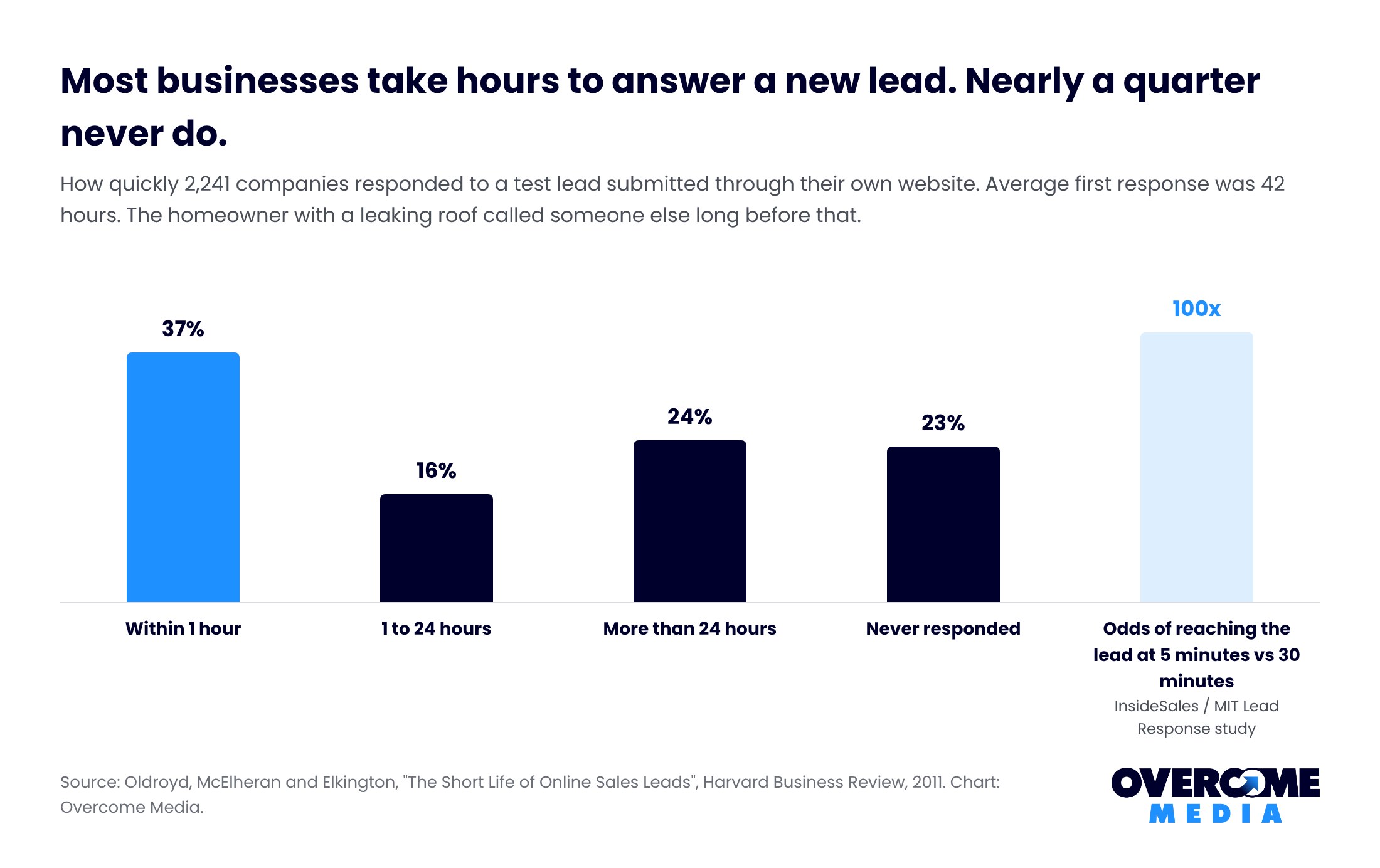
- In the largest audit of its kind, only 37 percent of businesses responded within an hour.
- 23 percent never responded at all.
- 82 percent of homeowners say they would call a competitor after an unanswered call.
- The fix is not a bigger office.
We run the lead response setup on every trades account we manage. The sequence in this guide is the one we install. The statistics come from the named studies, not from vendor blog posts. We checked.
In this guide
- What speed to lead means
- What the research actually says
- What happens to a missed call
- The missed call text back
- The response ladder, by lead source
- How to set it up in an afternoon
- How to measure it
- Frequently asked questions
What does speed to lead mean?
Speed to lead, or lead response time, is how long a new lead waits for a response from a person. A call that rings out has a slow speed to lead. So does a form that sits in an inbox until evening.
A call answered live has a speed to lead of zero.
For contractors it matters more than for almost any other business. The homeowner is in the middle of a problem and is working down a list. They called you because you were first on the map or first in the ad.
If you do not pick up, the second name on the list is one tap away. The job goes to whoever answers.
What does the research actually say about lead response time?
Two studies get quoted everywhere, usually without the details. Here they are with the details.
The Lead Response Management study (InsideSales with MIT, 2007) analyzed three years of data. That covered more than 15,000 leads and more than 100,000 call attempts across six companies.
The odds of making contact were about 100 times higher when the first call came within five minutes than at thirty. The odds of qualifying the lead were 21 times higher. Waiting an hour cut the odds of contact more than tenfold.
The Harvard Business Review audit (“The Short Life of Online Sales Leads”, Oldroyd, McElheran and Elkington, 2011) submitted test leads to 2,241 US companies and timed the response.
- 37 percent responded within an hour.
- 16 percent responded within a day.
- 24 percent took longer than a day.
- 23 percent never responded.
The average first response, for those that did respond, was 42 hours.
Both studies are old. Both were run on sales teams at desks, not on crews on roofs. We quote them anyway, for two reasons.
Nothing since has contradicted them. And a contractor’s situation is worse, not better. The person calling has an urgent problem. The person who should answer is holding a nail gun.
Want this done for you? Book a free 15 minute call or call (859) 710-8408. We will tell you what to fix first, no pitch.
What happens to a missed call at a contractor?
It mostly disappears. Invoca’s Home Services Lead Conversion Benchmarks report (July 2026) drew on calls across its home services customers. It found that 52 percent of callers reach a live person. Sub industries ranged from 32 to 74 percent.
Put the other way, about half of the people who call a home services business do not get a human.
What those callers do next is the expensive part. CallRail surveyed 1,000 US consumers in 2025. 82 percent said they would call a competitor after an unanswered call. 78 percent said they had abandoned a business for that reason.
Only 42 percent said they leave a voicemail. That is what they say they do. The voicemail boxes we listen to on client accounts suggest the real number is lower.
On the accounts we track, calls are 68 to 88 percent of all leads (the split is in our call tracking guide). Take a contractor getting 100 tracked calls a month. They answer half, and lose four in five of the unanswered ones to a competitor.
That is roughly 40 leads a month gone. They cost whatever the ads and the SEO cost to produce them. No marketing budget survives that.
What is a missed call text back and why does it work?
A missed call text back is an automatic text sent to any number that calls you and does not get answered. It goes out within seconds of the call ending.
It does one job. It reaches the caller before they dial the next company, and gives them a way to keep talking without waiting on hold.
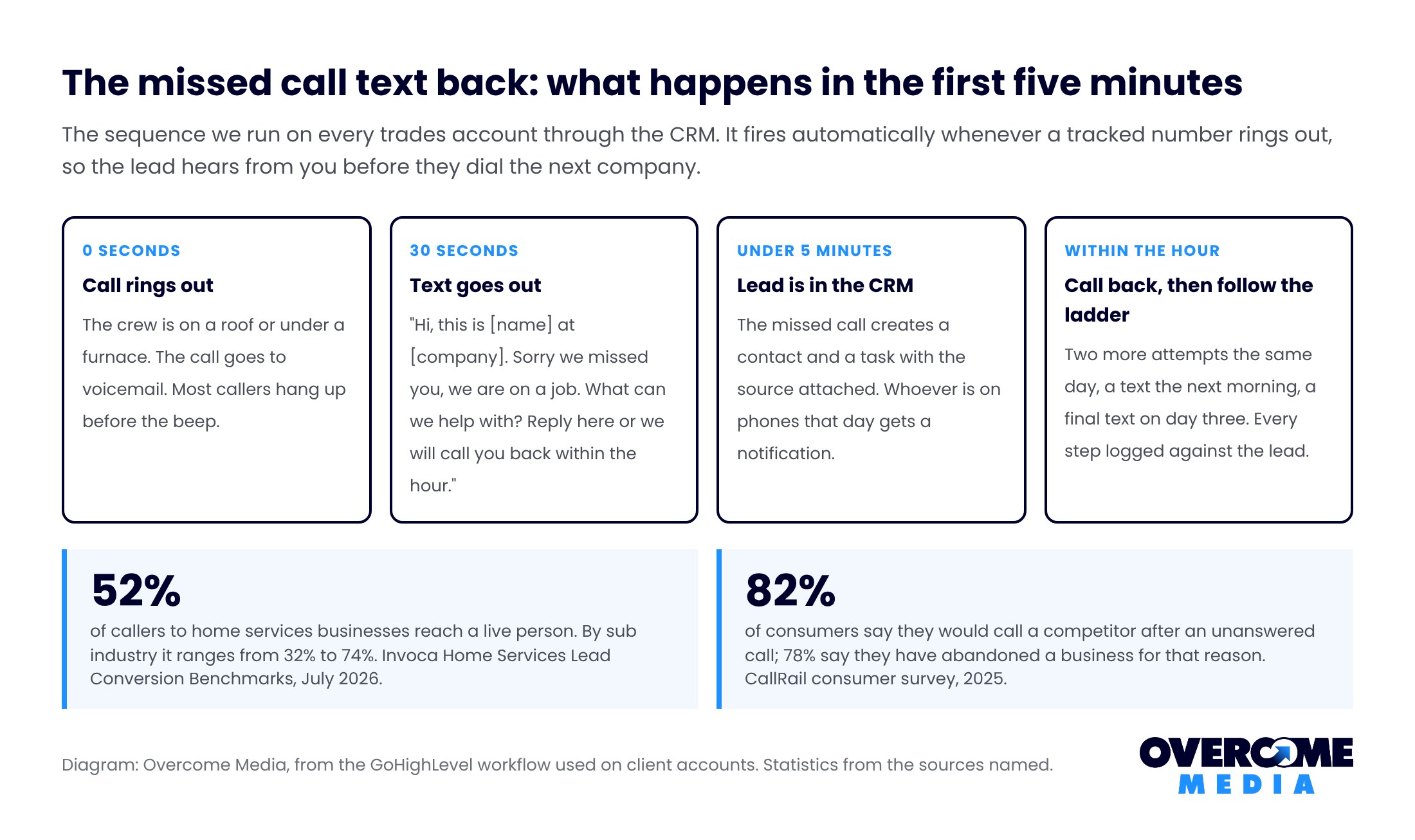
The message we use is short and sounds like a person: “Hi, this is [name] at [company]. Sorry we missed you, we are on a job. What can we help with? Reply here or we will call you back within the hour.”
It names a person, gives a reason, asks a question and sets a time. Each of those four parts earns replies. A bare “we missed your call” does not.
It works because of the five minute window above. The caller is still holding the phone. A text that arrives in 30 seconds lands while they are deciding whether to call the next listing.
A reply from them turns a lost call into a conversation your office can pick up between jobs. It is the single highest return automation we install. It costs nothing beyond the CRM you should already have.
Two rules. The text must come from a number the caller can text back and that a person actually monitors. Otherwise you have built a dead end.
And it is a bridge, not a replacement. The call back still has to happen, inside the hour you promised.
How fast should a contractor respond to each kind of lead?
Here is the standard we hold accounts to. The first row decides most jobs.
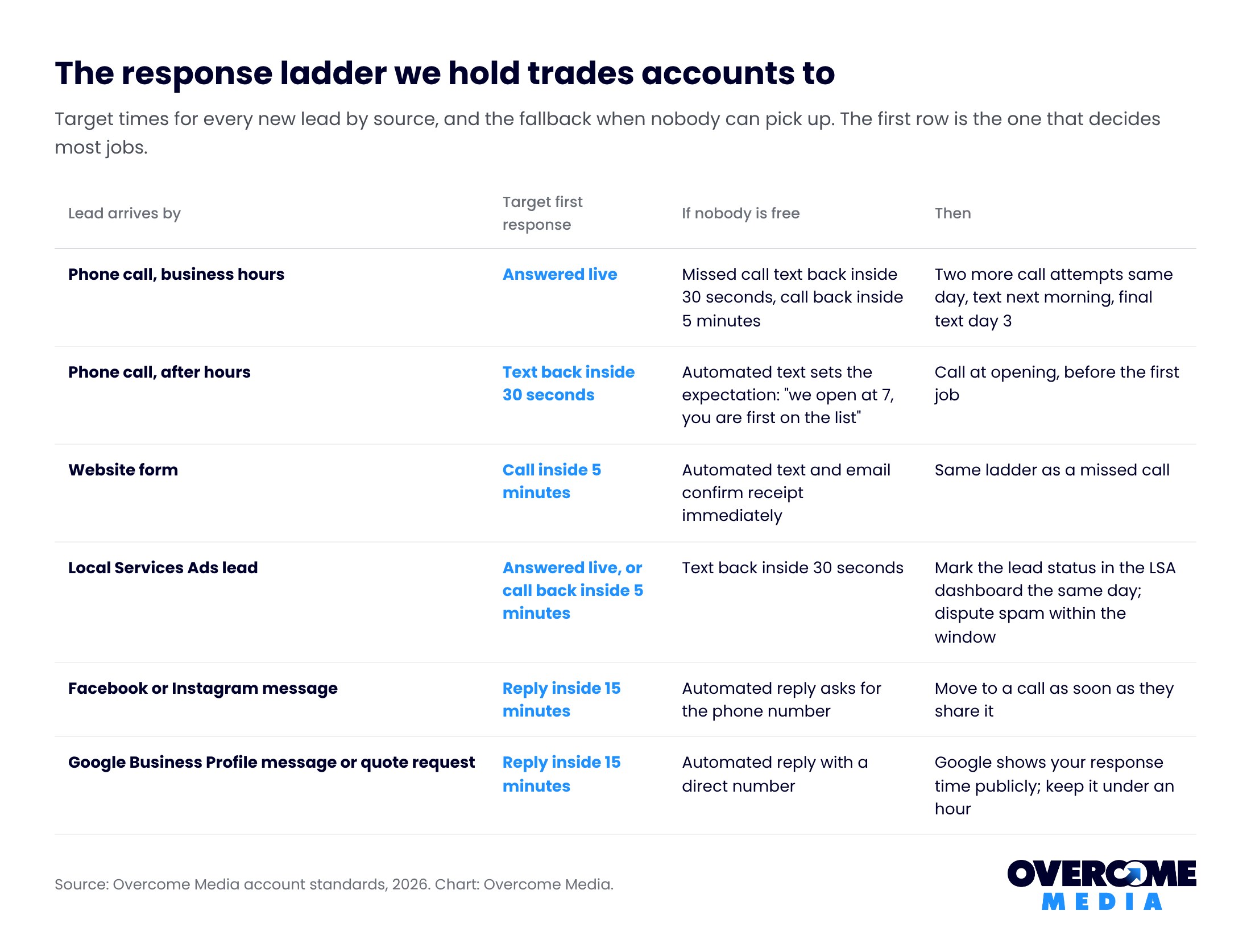
A few notes on the rows. Local Services Ads leads carry their own clock. Google charges for the lead whether you answer or not. Marking the lead status and disputing spam have deadlines, so those get handled the same day.
Google Business Profile messages show your typical response time publicly on the listing. Slow replies cost you twice.
After hours, the text back is the response. Nobody expects a roofer to pick up at 11 pm. They do expect to know they are first in line at 7.
How do you set up lead response in an afternoon?
- Put every lead source into one CRM. Calls (through call tracking), website forms, Local Services Ads leads, Facebook and Instagram messages, Business Profile messages. We use GoHighLevel. The point is one list that one person watches.
- Build the missed call text back. Trigger: inbound call on a tracked number, status missed. Wait 30 seconds, so a call that is being returned manually does not get a text too. Send the message above from the business texting number. Create a task for the on duty person.
- Build the form responder. Trigger: form submitted. Send a text and an email confirming receipt with a direct number. Create the same task.
- Decide who owns phones each day. Not “whoever is free”. A name on a rota, with the CRM app on their phone and notifications on. On a two person crew that is the person not on the ladder.
- Write the ladder into the CRM as tasks: call back inside the hour, two more attempts same day, text next morning, final text day three. Each one logged, so a lead cannot fall out of the sequence quietly.
- Test it from your own phone. Call the tracked number and let it ring out. You should have a text in 30 seconds and a task in the CRM. If either is missing, nothing else matters.
How do you measure speed to lead?
Three numbers, pulled from the CRM each week:
- The share of calls answered live. It should climb toward 80 percent in business hours.
- The median time from a missed call or form to the first human response. It should be under five minutes.
- The share of leads that got all the ladder steps. It should be 100 percent.
The third number never is 100 percent at first. That is why it gets measured.
Then tie it to money. With call tracking and the CRM connected, you can compare booking rates. Leads answered live, leads that went to the text back, and leads that got a call back the next day.
On every account we have looked at, that comparison ends the argument about hiring an answering service or putting someone on phones.
Frequently asked questions
What is a good lead response time for a contractor?
Under five minutes for a person to respond. Under 30 seconds for an automated text to acknowledge a missed call or a form. The research shows contact odds falling about 100 fold between five and thirty minutes.
Does a missed call text back annoy customers?
Not when it sounds like a person, gives a reason, asks what they need and promises a time. The texts that annoy say “we missed your call” and nothing else. Or they come from a number nobody monitors.
What percentage of calls do home services businesses miss?
Invoca’s 2026 home services benchmarks found 52 percent of callers reach a live person. That ranged from 32 to 74 percent by sub industry. So roughly half of callers do not get a human on the first try.
Should a contractor use an answering service?
Measure first. Check whether the CRM shows fewer than 60 percent of business hours calls answered live. If so, and the text back is not recovering enough of the rest, an answering service that can book from your calendar pays for itself on the first saved job.
If a text back plus a named person on phones gets you to 80 percent, you may not need one.
How many times should you follow up with a lead?
Our ladder is three call attempts on day one, a text the next morning and a final text on day three. Then the lead goes to a monthly check in list. Five touches in three days catches most people who wanted to talk. It stops before it becomes a nuisance.
Want to know how many of your calls are going unanswered?
We put tracking and the text back on every account before we spend on ads. We will show you the answered rate in the first 30 days. Request the free audit or call (859) 710-8408 and ask for the lead response check.
Overcome Media is a marketing agency in Lexington, Kentucky. We run lead tracking, CRM setup, SEO and paid ads for roofing, HVAC, junk removal and other trades businesses across Kentucky, Ohio and the surrounding states. Related: call tracking for contractors.
Sources
- Oldroyd, McElheran and Elkington, “The Short Life of Online Sales Leads”, Harvard Business Review, March 2011
- InsideSales.com and MIT, Lead Response Management Study, 2007
- The Invoca Home Services Lead Conversion Benchmarks Report 2026, July 2026
- CallRail, consumer survey of 1,000 US adults on unanswered business calls, 2025
- WhatConverts and GoHighLevel data from Overcome Media client accounts, 2026. Clients withheld.

Written by
Faisal Zaman
Senior SEO Strategist, Overcome Media
Faisal runs SEO for Overcome Media’s roofing, HVAC, junk removal and dumpster rental clients. He builds the Google Business Profile, location page and content plans that get blue collar companies into the map pack, and writes the Knowledge Base from what works on live client accounts.