 OvercomeMedia
How long does SEO take? For a contractor, about six to nine months to judge the whole program. The first results show far sooner than that. The honest answer depends on which fix you are talking about.
Key points
- A primary category change on the Google Business Profile can move the map inside a week.
- A page title rewrite can move a search term from page two to page one inside four weeks.
- New service and town pages start appearing in the first week and settle by week eight.
- Reviews, directory listings and links are the slow half, three to twelve months.
- The slow half is what holds a ranking once you have it.
- This guide gives the timeline lever by lever, with the dates we measured on real roofing, HVAC and junk removal accounts.
We run local SEO for trades businesses. We track every account on Google Search Console and a 49 point map grid. So the timings below are observed, not quoted from someone else’s blog. Where we give a number, we say where it came from.
In this guide
- The timeline, lever by lever
- What moves in days
- What moves in weeks
- What moves in months
- Why it takes as long as it does
- What makes it faster or slower
- When to judge it, and on what
- Frequently asked questions
How long does SEO take, part by part?
“How long does SEO take” has no single answer, because SEO is not one thing. It is a half dozen different changes to the Business Profile and the website. Google reacts to each on its own clock.
Here is the clock for each, as we have measured it in 2026.
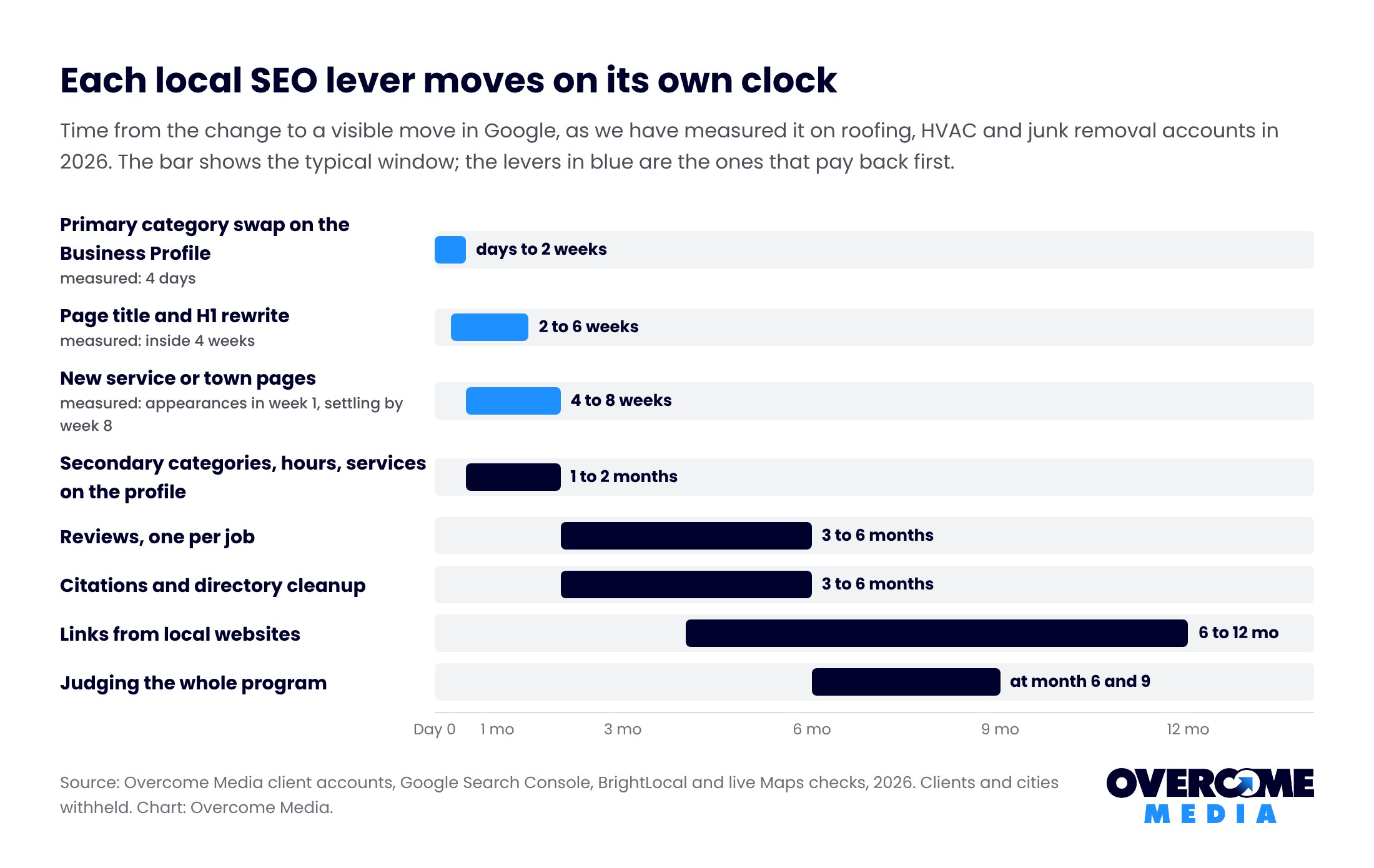
| Change | Typical time to a visible move | What we measured |
|---|---|---|
| Primary category swap on the Business Profile | Days to two weeks | Out of the top ten to second in the pack, four days |
| Page title and H1 rewrite | Two to six weeks | Five head terms from positions 12 to 28 down to 5 to 15, inside four weeks |
| New service or town pages | Four to eight weeks | Ten new pages, 681 appearances in their first four weeks |
| Secondary categories, hours, services, photos | One to two months | Map grid, run to run |
| Reviews at one per job | Three to six months | Competitor review velocity on three city maps |
| Citations and directory cleanup | Three to six months | Citation tracker on each account |
| Links from local websites | Six to twelve months | Link counts on the map grid competitor table |
What moves in days?
The primary category on the Google Business Profile. It is the single field Google weights most for relevance in the map. When it is wrong, fixing it is the fastest result in local SEO.
On one junk removal account in September 2026, the profile’s primary category was “Garbage collection service”. Searched from the shop, it ranked first and second for its home town.
Searched from the big city 20 miles away, it was not in the top ten. Every listing above it there used “Junk removal service” as the primary.
We swapped the primary, moved the old one to a secondary, and touched nothing else. Four days later the profile was second on “junk removal” in that city’s pack. The full story is in our junk removal SEO guide.
Two cautions. A category change puts the profile through a re-evaluation. If you batch it with a dozen other profile edits in the same week, any dip is impossible to read.
And “fast” only applies when the category was wrong to begin with. A profile that already has the right primary gets nothing from this lever.
Want this done for you? Book a free 15 minute call or call (859) 710-8408. We will tell you what to fix first, no pitch.
What moves in weeks?
Page titles and H1s: two to six weeks
On one roofing account, we rewrote the titles and H1s on three pages on August 24 and 25, 2026. We changed nothing else on the site in the window.
We compared the four weeks after with the four weeks before in Search Console:
- “roofing” went from an average position of 17.1 to 4.9.
- “roofing company” went from 19.0 to 6.2.
- “roofing contractors” went from 22.0 to 8.0.
- “emergency roof repair” went from 12.1 to 5.1.
Clicks went from 38 to 54. That is page two to page one in under a month, from the cheapest work in SEO. The charts are in the roofing SEO guide.
New pages: appearances in week one, settled by week eight
Google starts showing a new page for searches within days of indexing it. Where it ranks takes longer to settle.
On one junk removal site we built ten pages that had not existed before: a city page, construction debris, estate cleanouts, dumpster rentals, areas served, furniture, a second town, appliances, pianos and hot tubs.
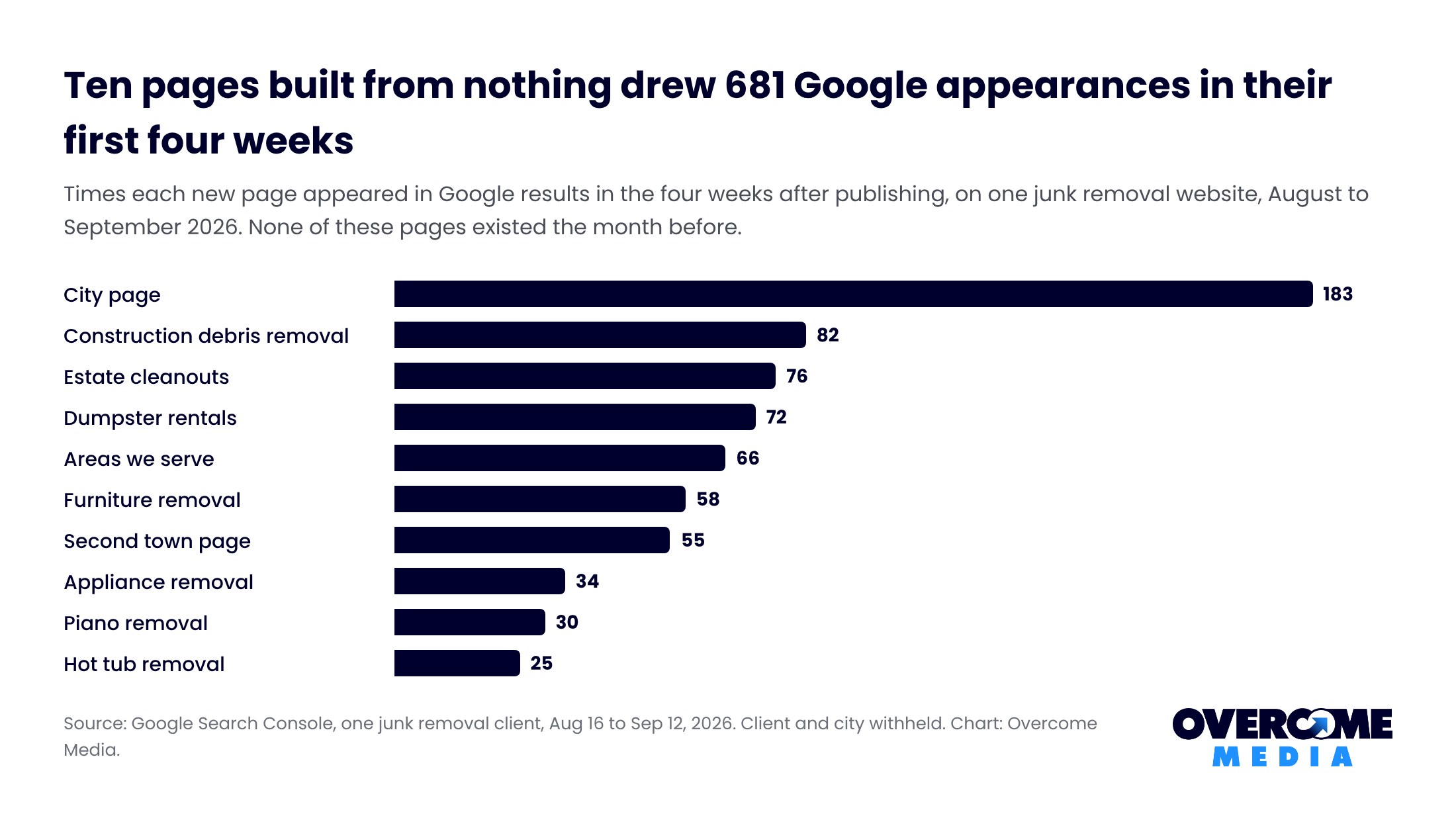
Together they drew 681 Google appearances in their first four weeks.
On the map grid, the longest standing of those service pages were averaging 1.6 for their terms by the end of the window. The newest, estate cleanout, was at 15.4. Same site, same profile, same month. The difference was how long each page had been live.
Plan on four to eight weeks before you judge a new page.
A rebuilt site: real movement in three weeks, page one in months
Expectations go wrong most often on new or rebuilt sites, so here is one. An HVAC website relaunched with eight town pages and six service pages. Search Console tracking started the day it went live.
Over the first 18 days it drew 2,200 appearances and 10 clicks at an average position of 30. Within that window, the last seven days were already better than the average for most tracked searches.
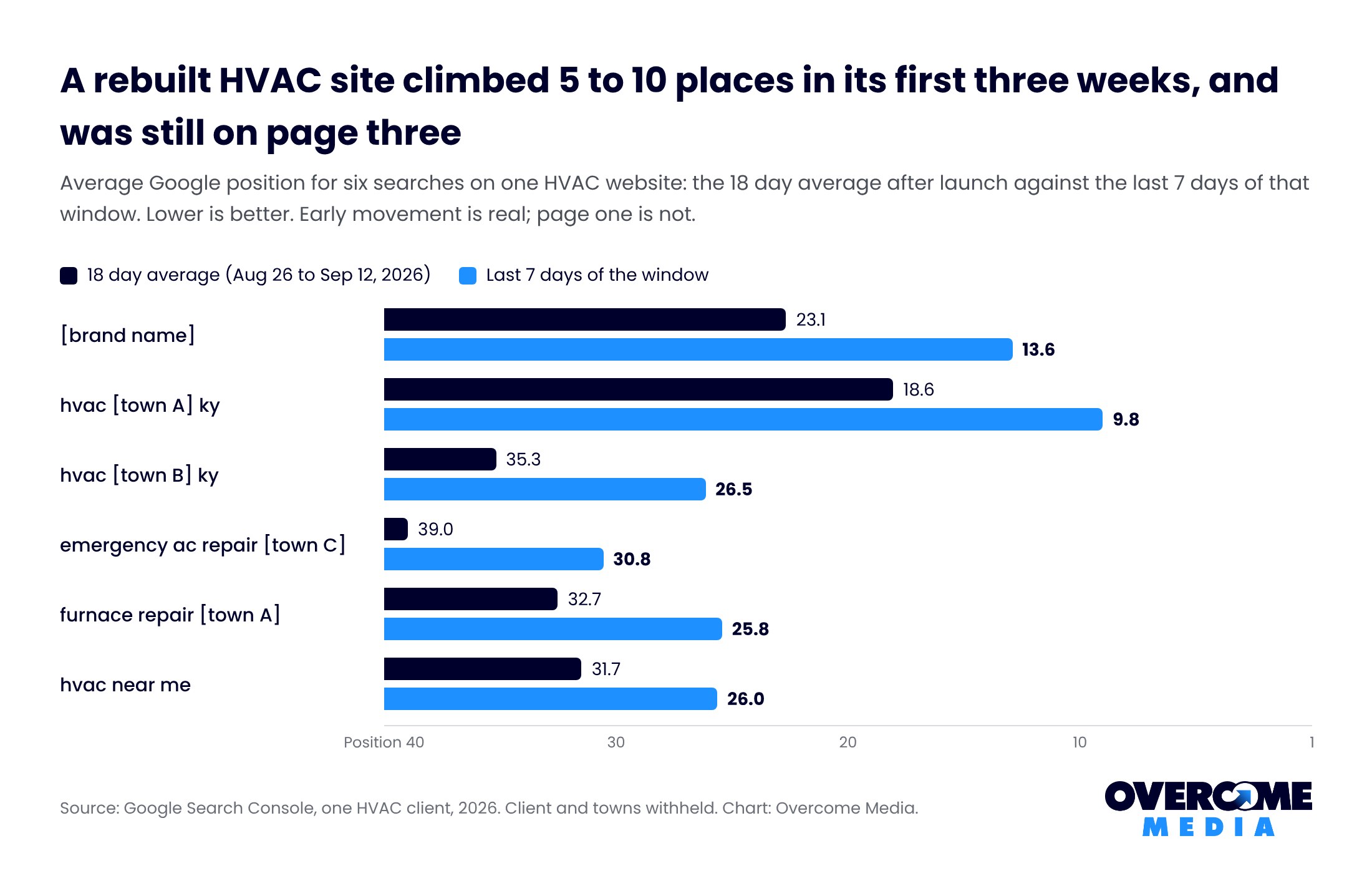
Five to ten places in three weeks is real progress. It is also still page three. That is where a new site with 24 reviews, two directory listings and twelve links belongs until the slow levers catch up.
We told the owner exactly that. We judged the site on direction, not on position, until month three.
What moves in months?
Everything that depends on other people: reviews, directory listings and links. These are the prominence half of Google’s ranking formula. Prominence is accumulated, not switched on.
Reviews work on velocity more than total. On the three city maps we study most closely, the median competitor added between two and six Google reviews a month. One outlier added over a hundred.
A contractor who starts asking for one review per completed job will be the fastest growing profile on most maps inside a quarter. Google starts to credit that in the second and third month, not the first.
Citations are your name, address and phone in the directories Google checks. They take a few weeks to submit and one to three months to be crawled and matched.
A new HVAC account we audited was listed in 2 of 42 directories. A junk removal account was in 5 of 38, with the address right on only one. Cleaning that up is unglamorous work that shows in month three.
Links are the slowest. On one roofing map the companies above our client held 205 to 1,380 linking websites against 15.
Earning the first fifty from suppliers, the chamber, associations, sponsorships and local press is a six to twelve month project. It is also what makes a ranking hard to lose.
Why does SEO take as long as it does?
Three reasons, none of them mysterious.
- Google has to recrawl a page before it can react to a change. For a small contractor site that happens every few days to every few weeks, not every hour.
- Google then needs evidence that the change holds. A page that ranks fifth for one day is a test. A page that ranks fifth for a month is a result.
- Prominence signals (reviews, listings, links) are counts of things other people have done. They cannot be sped past a certain rate without looking bought.
Google’s own guidance on local ranking lists relevance, distance and prominence. It says prominence is based partly on “how many websites link to your business and how many reviews you have” (Google Business Profile Help).
Relevance and distance are the parts you can fix in a week. Prominence is the part that takes the year.
What makes it faster or slower?
- How wrong the basics are. A profile on the wrong primary category or a site with “Home” as its homepage title has fast wins waiting. A site that already has the basics right has only the slow levers left.
- How crowded the map is. A pack where the top three hold 400 to 1,700 reviews and hundreds of links takes longer to crack. One where several listings have a single review is faster.
- Whether the crew asks for reviews. This is the lever most owners control and most owners skip. It is the difference between month four and month nine.
- Seasonality. Roofing demand peaks after storms, HVAC after the first hot and first cold week, junk removal on spring weekends. A fix made in the off season looks like nothing until the season arrives. Compare the same season year on year, not month to month.
- Measurement day. One junk removal profile listed Sunday as closed. Every Sunday rank report showed a collapse from 4th to 17th while weekday runs were fine. Check what day your reports run before you conclude anything.
- Batching changes. Many profile edits in a few days cause a re-evaluation dip that hides whether any of them worked. Change, wait two weeks, measure, then change the next thing.
When should a contractor judge local SEO, and on what?
Judge the program at month six and again at month nine. Before that, judge direction and whether the work shipped.
What you should see along the way:
- By the end of month one, the profile fixes are live and the first title changes show in Search Console.
- By month three, new pages are drawing appearances and the map grid is moving on the terms those pages target.
- By month six, calls from the profile and the site are up against the same months last year.
If an agency cannot show you Search Console and a map grid at month three, ask why.
Measure calls and booked jobs, not just positions. On one roofing account the Business Profile sent 42 percent of all organic website clicks on its own. That number is in the profile’s own reports.
Rankings are the means. The phone ringing is the result.
Frequently asked questions
How long does it take to rank on Google Maps?
Profile fixes such as the primary category can move the map within days. A meaningful, lasting move into the 3 pack usually takes three to six months, because it depends on reviews and listings building up. In a crowded city pack it can take longer.
How long does it take for a new website to rank?
Appearances start within days of indexing. On one rebuilt HVAC site, tracked searches improved five to ten places in the first three weeks but were still on page three.
Plan on three months for page two and six or more for page one on competitive terms. The slow levers decide the rest.
Can local SEO work in 30 days?
Some of it can. A category fix, a title rewrite and a corrected phone number can all show inside 30 days. On one roofing site a title rewrite alone moved head terms from page two to page one in under a month.
The program as a whole cannot be judged that fast.
Why did my rankings drop right after I made changes?
Usually one of three things: a profile re-evaluation after a batch of edits, a report that ran on a day the business is listed as closed, or seasonal demand shifting. Check all three before assuming the change was wrong. Wait two weeks and re-run the measurement.
How long should I give an SEO agency?
Ask for proof of shipped work at month one. Ask for movement in Search Console and on a map grid at month three. Ask for calls up year on year at month six.
Judge the whole engagement at month six and nine. Most trades businesses that hire an agency pay $2,000 to $6,000 a month. That is a real amount of money to spend without those checkpoints.
Want to know which levers your business still has?
We will run the same checks we ran above on your site and Business Profile. We send back what we find, with the three things that would move first. No call required. Request the free SEO audit or call (859) 710-8408.
Overcome Media is a marketing agency in Lexington, Kentucky. We run local SEO for roofing, HVAC, junk removal and other trades businesses across Kentucky, Ohio and the surrounding states. Trade specific guides: roofing SEO, HVAC SEO and junk removal SEO.
Sources
- How to improve your local ranking on Google, Google Business Profile Help
- Google Search Console, BrightLocal Local Search Grid and live Google Maps data from Overcome Media roofing, HVAC and junk removal clients, August to September 2026. Clients and cities withheld.

Written by
Faisal Zaman
Senior SEO Strategist, Overcome Media
Faisal runs SEO for Overcome Media’s roofing, HVAC, junk removal and dumpster rental clients. He builds the Google Business Profile, location page and content plans that get blue collar companies into the map pack, and writes the Knowledge Base from what works on live client accounts.