 OvercomeMedia
Google Ads for contractors comes in three formats: Local Services Ads, search ads and Performance Max. Run Local Services Ads first, search ads second for the big ticket jobs, and Performance Max rarely. Judge every budget on cost per booked job, not the platform’s cost per lead.
Key points
- Local Services Ads charge per lead and sit above the map with a Google Guaranteed badge.
- Search ads charge per click and match what the person typed.
- Performance Max places the ad wherever Google’s model decides.
- On our accounts a lawn care search campaign produced 193 tracked leads at $31.36 each over its peak season.
- A junk removal Local Services Ads account ran at $15.09 a charged lead. HVAC and roofing benchmarks run higher because the jobs are bigger.
- Measure cost per booked job by job type, over a season, with call tracking. The platform’s cost per lead is not the number that pays the crew.
We manage Google Ads and Local Services Ads for trades businesses. We install tracking before we spend a dollar. The figures from our own accounts are marked as such, and the rest are labeled industry benchmarks.
In this guide
- What to have in place before running ads
- Local Services Ads vs search vs Performance Max
- Local Services Ads: setup and management
- Search ads: how to build the campaign
- Conversions: tracking calls, not clicks
- Budget and seasonality
- What Google Ads costs a contractor
- How to judge a campaign
- Frequently asked questions
What should a contractor have in place before running Google Ads?
Four things, in this order, because ads multiply whatever they land on.
- A Google Business Profile with the right categories, true hours and recent reviews. Local Services Ads rank partly on the profile, and search ads show the profile’s rating next to the ad.
- A website with a page per job type and a phone number at the top. An ad that lands on the home page pays for a click and gets a bounce.
- Call tracking with a number for each ad channel. Then the conversion the campaign optimizes toward is a real call and not a page view.
- Someone answering the phone, with a missed call text back for when they cannot. A paid lead that rings out is the most expensive lead there is.
We sequence it this way on every account: CRM, profile, website, tracking, then paid. The free channels come first, in the local SEO guide. Then ads go on top of a foundation that converts.
Local Services Ads vs search ads vs Performance Max: which should a contractor run?
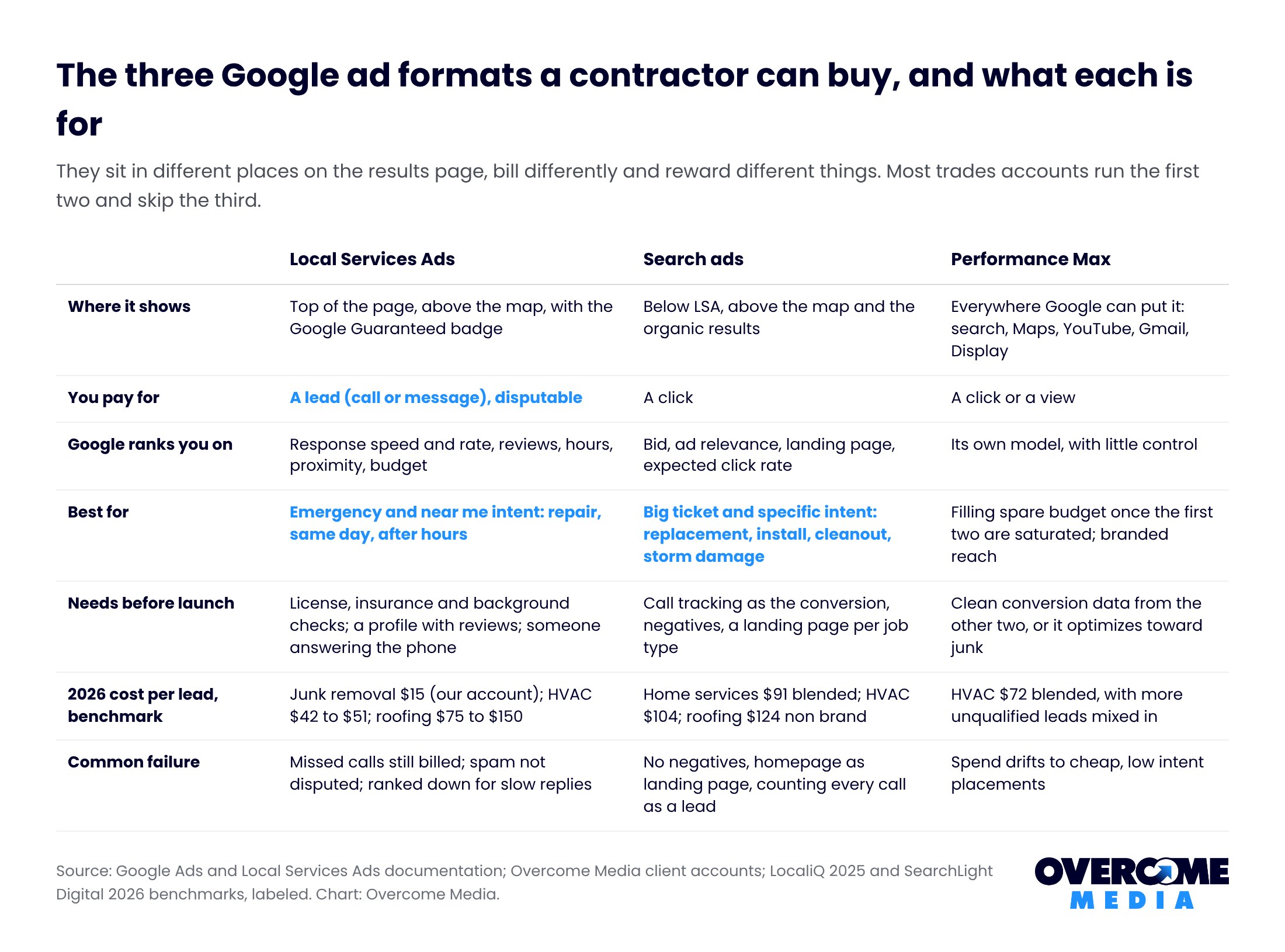
Local Services Ads first. You pay per lead rather than per click, and you can dispute the leads that were not real. It sits at the very top of the page for emergency and near me searches, where intent is highest.
Search ads second, for the specific and expensive jobs: replacements, installs, cleanouts, storm damage. You want control over the keyword, the ad and the landing page.
Performance Max only once the first two are saturated and the conversion data is clean. It optimizes toward whatever it is fed. Fed page views, it will find you cheap, worthless clicks all day.
How do Local Services Ads work for contractors?
You apply with your license, insurance and a background check. Google verifies them, and your listing shows above the map with the Google Guaranteed badge. You set a weekly budget and a service area.
When someone calls or messages through the listing, Google charges you for the lead. You can dispute leads that were spam, out of area, a job seeker or not a service request.
On a junk removal account we run, that produced 20 charged leads at $15.09 each in September 2026. Industry benchmarks for 2026 put HVAC leads at $42 to $51 and roofing at $75 to $150. Those are higher because the jobs are bigger and the competition pays more.
Google ranks LSA listings on response.
- How fast you answer.
- How many leads you answer.
- Your review count and rating.
- Your hours.
- Your proximity.
So the management of an LSA account is mostly operational.
- Answer live.
- Text back missed calls inside 30 seconds.
- Mark every lead’s status in the dashboard the same day (booked, not booked, archived). Google uses that too.
- Dispute the junk inside the window.
- Keep the profile’s reviews moving.
- Adjust the budget by season rather than letting it run flat.
The technical setup takes an afternoon. The response discipline is the work.
Want this done for you? Book a free 15 minute call or call (859) 710-8408. We will tell you what to fix first, no pitch.
How do you build a search campaign for a contractor?
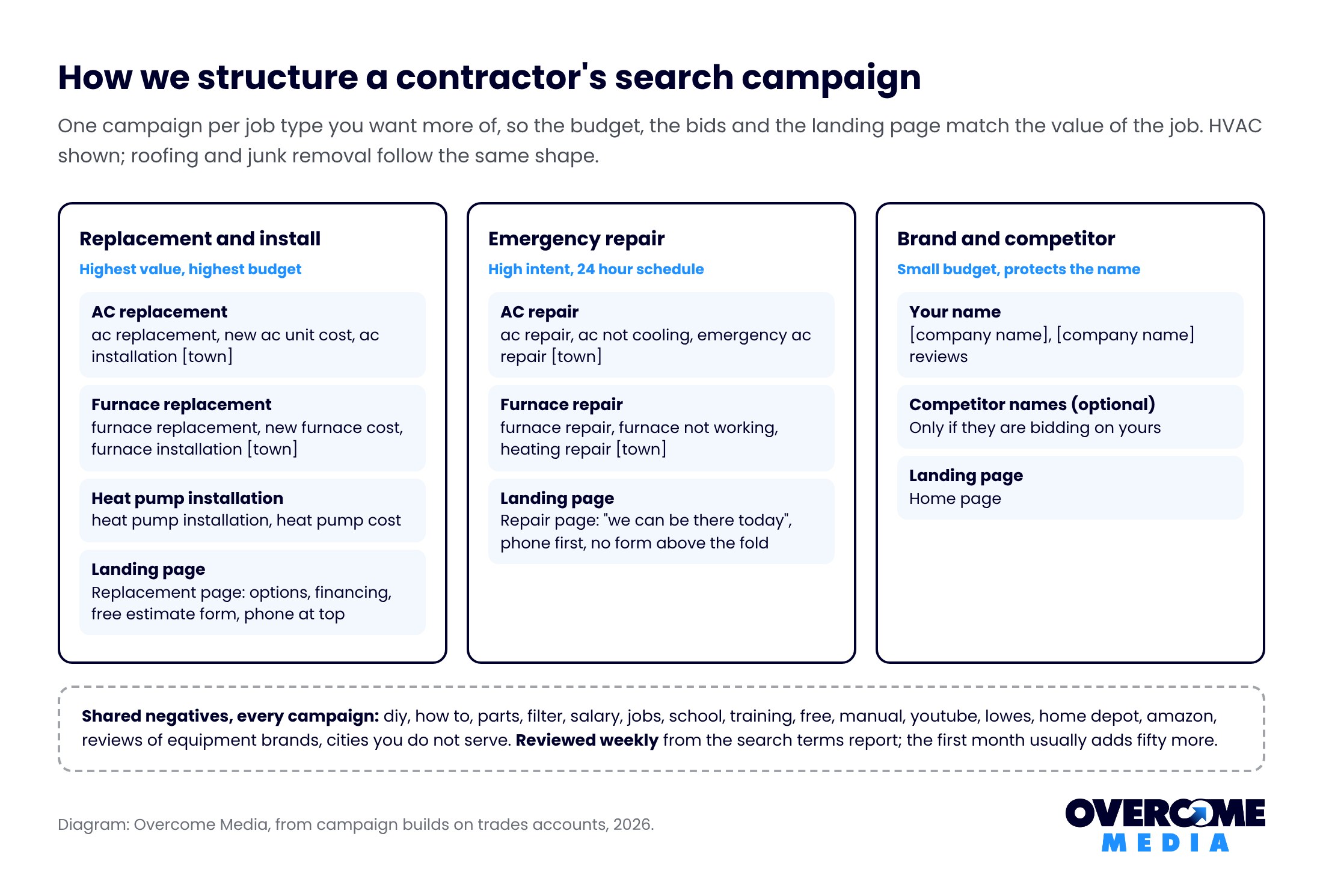
One campaign per job type you want more of. Then the budget, the bids and the landing page match what the job is worth.
For an HVAC company that is three campaigns.
- A replacement and install campaign (highest value, highest budget).
- An emergency repair campaign (highest intent, running 24 hours with a phone first landing page).
- A small brand campaign that protects the company name.
A roofer runs replacement and storm damage, repair, and brand. A hauler runs cleanouts and multi item jobs, single items, and brand.
Inside each campaign, three things.
- Tight ad groups of a few closely related searches.
- Ads that say the service and the town and carry a call button.
- A landing page about that job type with the phone number at the top and a short form below.
Match types matter. Use phrase and exact match on the money terms. Use broad match only where you have the conversion data to let Google learn from it.
Add negatives from day one. Start with diy, how to, parts, filter, salary, jobs, school, training, free and manual. Add the big box retailers, equipment brand reviews, and every town you do not serve.
The search terms report in the first month usually adds fifty more. Skipping negatives is the single most common way a contractor’s budget disappears.
What should the campaign count as a conversion?
A qualified call or a form that became a conversation, and nothing else. On the trades accounts we track, calls are 68 to 88 percent of all leads. A campaign optimizing toward form fills is optimizing toward a tenth of the picture.
Call tracking assigns the ads a number and swaps it onto the site for visitors who arrived from an ad. It records the call.
It imports the call into Google Ads as a conversion only if it was qualified. Qualified means a real customer, in your area, asking for a service you sell. Google then bids toward people who call and book, not people who click.
Without that, two things go wrong. The campaign learns from the wrong signal. The report shows a cost per lead that includes spam, vendors and wrong numbers.
The call tracking guide has the setup. The short version is that it takes a day. It is the difference between a campaign that improves every month and one that does not.
How much should a contractor budget, and when?
Enough to get a readable number. At $100 a lead, a $1,000 a month budget produces ten leads. That is not enough to tell whether the campaign works.
For search ads in HVAC and roofing, most single location companies start at $2,000 to $5,000 a month in spend. Junk removal and lawn care, with cheaper clicks and leads, can start lower.
For Local Services Ads, set the weekly budget to the number of leads you can actually answer. Google will spend it.
Then move it with the season.
- HVAC search volume spikes in the first hot week and the first cold week.
- Roofing triples for two weeks after hail.
- Junk removal peaks on spring weekends and at move out time.
- Lawn care runs March to June.
Budgets that sit flat all year overspend in the quiet months and get outbid in the busy ones. We set a base budget and a seasonal multiplier per campaign. We have the budget doubled before the weather turns, not after.
What do Google Ads for contractors cost?
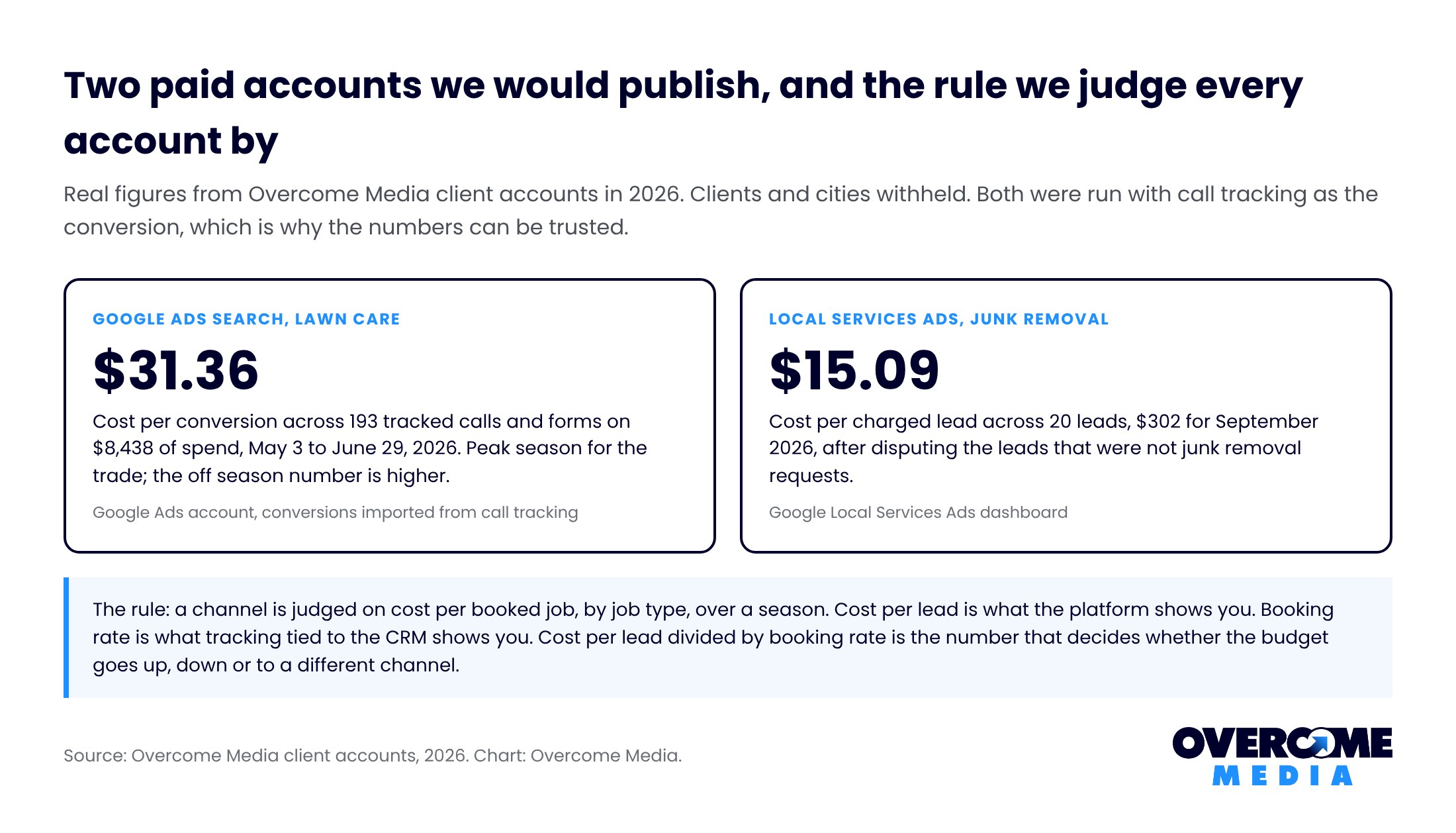
Two numbers from our own accounts, and the benchmarks for the rest.
A lawn care search campaign, May 3 to June 29, 2026: $8,438 spent, 193 tracked conversions, $31.36 each, in peak season. A junk removal Local Services Ads account, September 2026: $302 for 20 charged leads, $15.09 each.
For the bigger trades, these are the 2026 benchmarks we trust.
- Home services search at about $91 a lead blended.
- HVAC at $104 blended and $149 on non brand searches.
- Roofing at $124 on non brand searches.
- Local Services Ads at $42 to $51 for HVAC and $75 to $150 for roofing.
Management is the other cost. Most trades businesses that hire an agency pay between $2,000 and $6,000 a month as of October 2026. That covers ads management, SEO and tracking.
The ad spend itself is on top. An agency earns that fee only if it is reporting cost per booked job by campaign, which brings us to the rule.
How do you judge Google Ads for contractors?
Cost per booked job, by job type, over a season. That is cost per lead divided by booking rate.
A $42 HVAC lead that books at 40 percent is a $105 job. The same lead booking at 15 percent is a $280 job. The difference is the phone, not the bid.
A $124 roofing lead at a 30 percent close is $413 against an $11,000 to $25,000 contract. The same lead on a $300 repair is a loss.
So the judgment is made per campaign, with the job value attached. Compare with the same months last year rather than last month.
Three checkpoints.
- At 30 days: is tracking working, are the negatives in, is the search terms report clean?
- At 90 days: what is cost per booked job by campaign, and which campaign should get the next dollar?
- At the end of the season: did the paid channel produce jobs at a cost the margin supports? Would the same money have done more in the free channels?
The leads guides for roofing, HVAC and junk removal rank every channel that way.
Frequently asked questions
Are Google Ads worth it for contractors?
Yes for the jobs big enough to carry the lead cost: replacements, installs, cleanouts, storm work. Not on their own for small repairs or single item pickups, where the lead can cost more than the margin.
Local Services Ads are worth it in almost every trade. You pay per lead and can dispute the bad ones.
What is the difference between Local Services Ads and Google Ads?
Local Services Ads sit above the map and show a Google Guaranteed badge. They charge per lead and rank on your responsiveness and reviews.
Google search ads sit below them, charge per click, and rank on your bid, ad and landing page. Most contractors should run both, LSA first.
How much do Google Ads cost per lead for contractors?
From our accounts in 2026: $31.36 per conversion on a lawn care search campaign. And $15.09 per Local Services Ads lead in junk removal.
Benchmarks put home services search at about $91 a lead, HVAC at $104 to $149 and roofing at $124. Local Services Ads run $42 to $51 for HVAC and $75 to $150 for roofing.
Should a contractor run Google Ads before SEO?
Run ads once the profile, the website and the tracking are in place. That takes a few weeks, not months. Ads multiply whatever they land on.
An ad that lands on a home page with no phone number and no reviews pays for clicks. Those clicks do not convert. The two then run together, with SEO lowering the cost per job every month.
Should a contractor use Performance Max?
Not until Local Services Ads and search are saturated and the conversion data is clean. Performance Max optimizes toward whatever conversion it is given. On accounts without qualified call tracking it drifts to cheap, low intent placements.
Benchmarks show a lower cost per lead with more unqualified leads mixed in.
Want to know what your ads are really costing per job?
We will look at the account, the tracking and the landing pages. We will tell you what is working, what to cut and what the first 30 days of a rebuild would look like.
No call required. See the paid advertising service or request the free audit or call (859) 710-8408.
Overcome Media is a marketing agency in Lexington, Kentucky. We run Google Ads, Local Services Ads, SEO and lead tracking for trades businesses. We work across Kentucky, Ohio and the surrounding states. See the industries we work in.
Sources
- Google Ads and Google Local Services Ads account data from Overcome Media lawn care and junk removal clients, May to September 2026; WhatConverts lead logs from construction and dumpster rental clients. Clients and cities withheld.
- LocaliQ, Search Advertising Benchmarks for Home Services, 2025; SearchLight Digital HVAC and roofing benchmarks, January to March 2026; BaaDigi and Blue Grid Media Local Services Ads benchmarks, 2026
- Google Ads Help and Local Services Ads Help, ranking and dispute documentation

Written by
Faisal Zaman
Senior SEO Strategist, Overcome Media
Faisal runs SEO for Overcome Media’s roofing, HVAC, junk removal and dumpster rental clients. He builds the Google Business Profile, location page and content plans that get blue collar companies into the map pack, and writes the Knowledge Base from what works on live client accounts.