 OvercomeMedia
Local SEO for contractors is the work that gets a trades business to show up when someone nearby searches for what it does. That means the Google Maps 3 pack and the website results under it. The goal is to turn that visibility into calls.
Key points
- It has three parts: the Google Business Profile, the website, and the tracking underneath.
- The profile side is categories, reviews, hours, photos and citations.
- The website side is a page per service and per town, with titles that say the search.
- Tracking tells you which one produced the job.
- Fast levers like a category fix or a title rewrite show in days to weeks.
- Slow levers like reviews, citations and links take a quarter or more.
This guide is the whole system in one place. The trade specific guides linked throughout carry the data for roofing, HVAC and junk removal.
We run local SEO for roofing, HVAC, junk removal, dumpster rental, lawn care and construction companies. We track every account on Google Search Console and a 49 point map grid. Every figure here is from those accounts or from Google’s own documentation.
In this guide
- What local SEO is for a contractor
- How Google ranks local businesses
- Part 1: the Google Business Profile
- Part 2: the website
- Part 3: tracking
- The first 90 days
- How long it takes
- What it costs
- Local SEO by trade
- Frequently asked questions
What is local SEO for a contractor?
When a homeowner searches “roofer near me”, “ac repair [town]” or “junk removal”, Google shows two things on one screen. A map with three businesses, and under it a list of websites.
Local SEO is the work of winning both for the searches that matter in the towns you serve. They are two different jobs because Google ranks them on different signals.
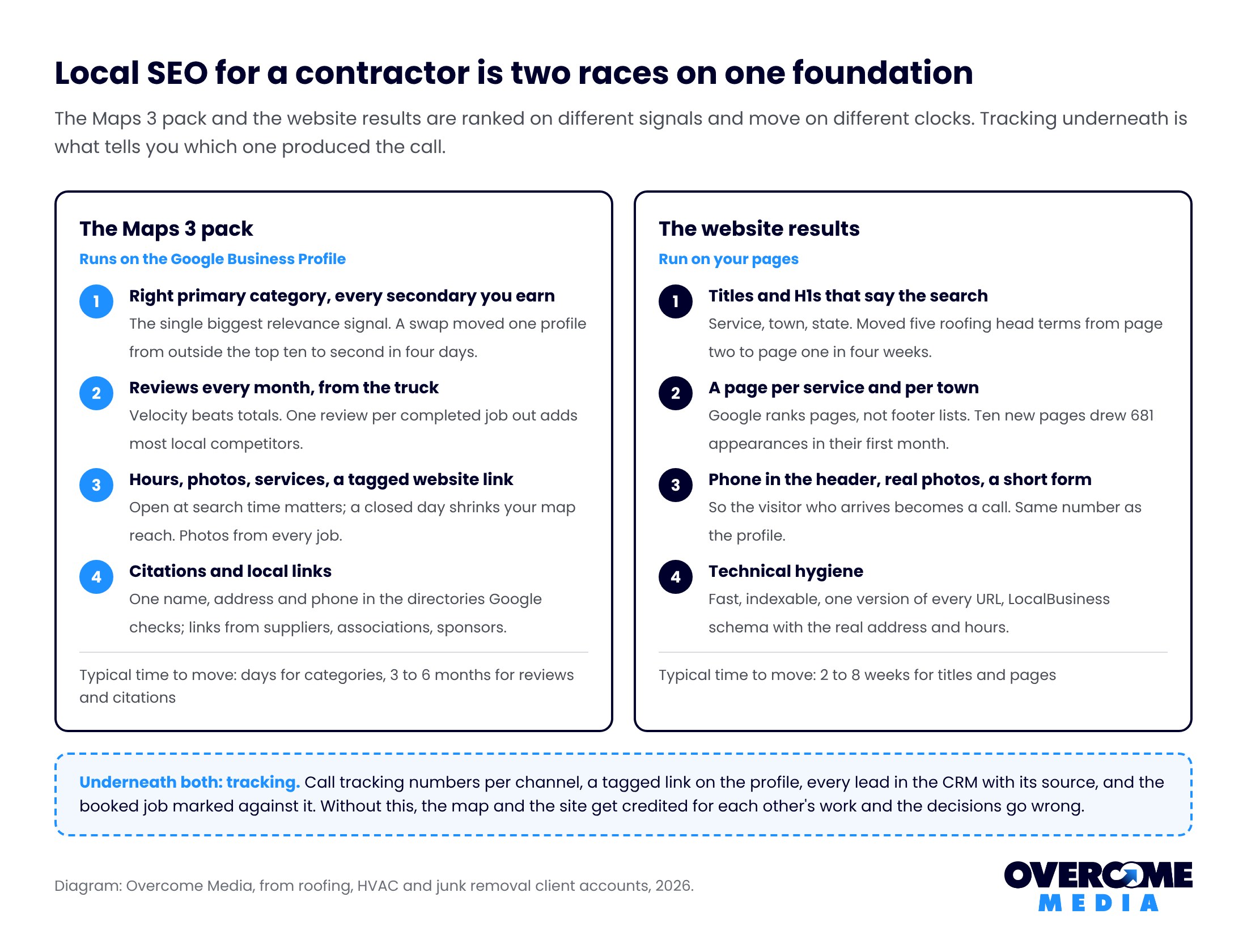
The Maps 3 pack runs on the Google Business Profile. That means categories, reviews, hours and photos. It also means a consistent name, address and phone across the web.
The website results run on your pages. Three things matter.
- A page exists for the service and the town.
- Its title says what the searcher typed.
- Other sites point to it.
A contractor can win one, both or neither. Most lose both for reasons that have nothing to do with the quality of the work.
How does Google rank local businesses?
Google says local results are based on three factors: relevance, distance and prominence. In its own words, relevance is “how well a Business Profile matches what someone is searching for”. Distance is “how far each business is from the customer who’s searching”.
Prominence is “how well-known a business is”. Google says that is based partly on “how many websites link to your business and how many reviews you have” (Google Business Profile Help).
For a contractor the practical reading is this. Relevance is decided by categories on the profile and page titles on the site. You control both completely.
Distance is decided by where the searcher is, which you cannot control. It is also decided by whether you have a town page and a service area for the places you want calls from. That part you can control.
Prominence is reviews, directory listings and links, accumulated over time. The first two factors can be fixed in a week. The third is the year’s work.
Part 1: what does the Google Business Profile need?
The right primary category, and every secondary you earn
The primary category is the single strongest relevance signal in the map. It is wrong more often than owners think.
One junk removal profile we took over was filed as “Garbage collection service”. It ranked first in its own town. It was absent from the top ten in the city 20 miles away, where every listing above it used “Junk removal service”.
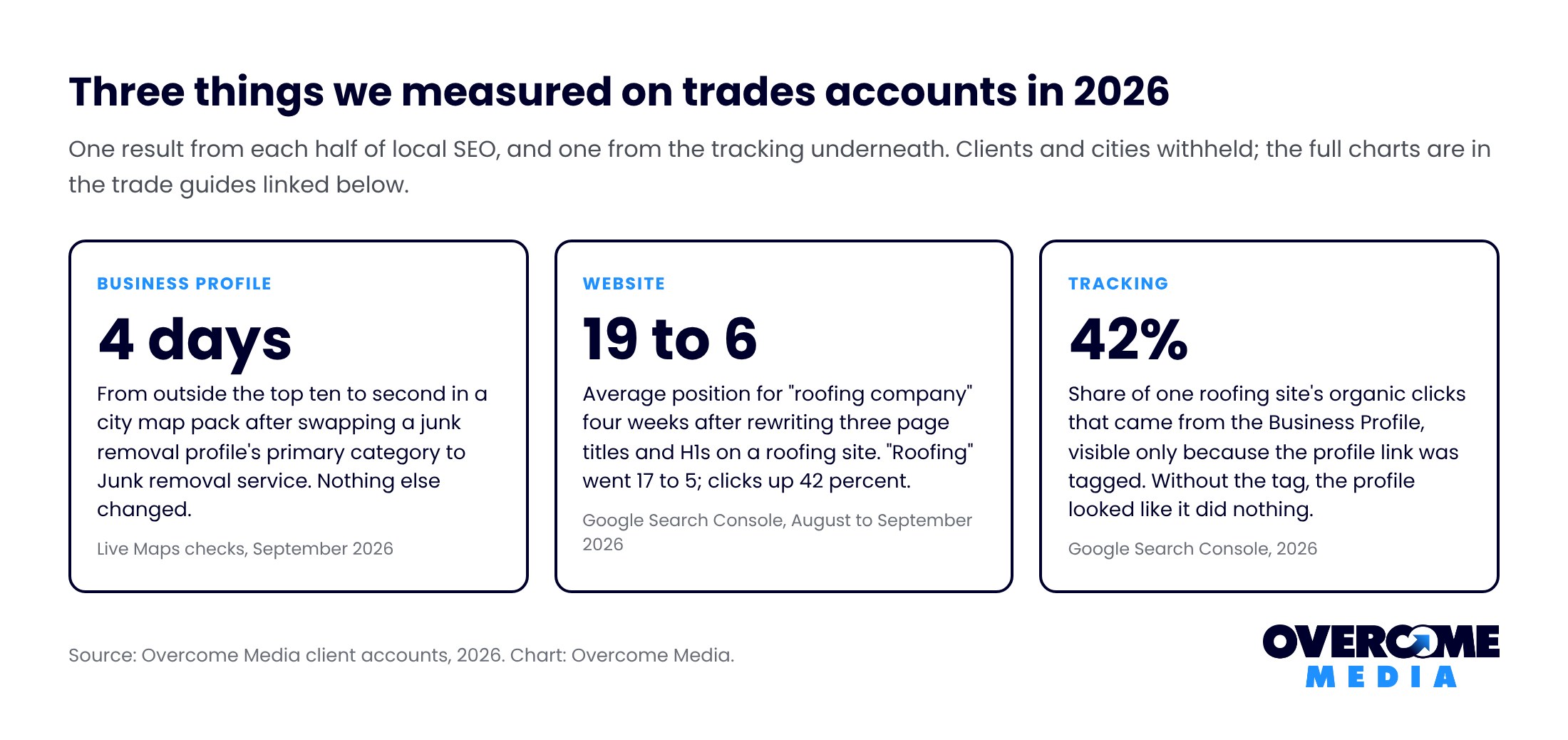
We swapped the primary and nothing else. Four days later it was second in that city’s pack.
Secondary categories add searches the profile can appear for. An HVAC profile with only “HVAC contractor” is weak for “furnace repair”. One that also carries Heating contractor and Furnace repair service is far more relevant.
Add every one you actually sell, and none you do not.
Reviews every month, asked from the truck
Owners look at the total and give up. On one roofing city map the top six held 107 to 700 reviews. A company with 15 cannot catch that and does not need to.
What we measured instead was how many each added over 24 days. The number one business added none. The local median was about four a month.
Ask for one review per completed job. You will be the fastest growing profile on most maps inside a quarter. Local ranking studies consistently find recent reviews count for more than old ones.
The ask is a text with the link, sent by the crew lead before pulling away. Reply to every review.
Hours, photos, services, and a tagged link
Google favors businesses that are open at the time of the search. One junk removal profile listed Sunday as closed. Every Sunday its map rank fell from 4th to 17th, while weekday runs were fine.
List the hours you keep, and know what a closed day costs.
Upload photos from every job, weekly, from the crew’s phones. One hauling profile we audited had 69 against competitors’ 256 to 875. Fill out the services list with descriptions.
Add a tag to the website link, something like ?utm_source=google&utm_medium=organic&utm_campaign=gbp. That lets you tell map clicks apart from the rest of organic search. On one roofing account that tag revealed the profile sending 42 percent of all organic clicks.
Citations and local links
Citations are your name, address and phone in the directories Google checks. One HVAC account we audited was listed in 2 of 42. A junk removal account was in 5 of 38, with the address right on one.
Pick one form of the business name and use it everywhere.
Links come from suppliers’ dealer locators, the chamber, trade associations, sponsorships and local press. They are the slowest lever. On one roofing map the companies above our client held 205 to 1,380 linking websites against 15.
They come last, and they are what makes a ranking hard to lose.
Want this done for you? Book a free 15 minute call or call (859) 710-8408. We will tell you what to fix first, no pitch.
Part 2: what does the website need?
Titles and H1s that say the search
The cheapest work in SEO. On one roofing site we rewrote the titles and H1s on three pages in late August 2026. We changed nothing else.
Four weeks later the rankings had moved.
- “Roofing company” moved from an average position of 19.0 to 6.2.
- “Roofing contractors” moved from 22.0 to 8.0.
- “Roofing” moved from 17.1 to 4.9.
- Clicks were up 42 percent.
Every service page and every town page gets a title with the service, the town and the state. “Roof Replacement in [Town], [State]”, not “Services”.
A page per service and per town
Google ranks pages, not businesses. People search for the specific thing: “heat pump installation”, “hot tub removal”, “storm damage roof repair”.
On one HVAC site, three of the ten most searched services had no page. The site ranked in the 30s and 40s for all of them. On one junk removal site, ten pages built from nothing drew 681 Google appearances in their first four weeks.
Each page has to be about its subject. What you do, what it costs or how pricing works, and photos of your own jobs there.
A footer list of 30 towns is not coverage. Eleven of sixteen cloned service pages on one site ranked for nothing at all.
Built to turn a visitor into a call
- Phone number in the header, the same number as the profile.
- Real job photos.
- A short form for people who will not call.
- Fast on a phone.
Then the technical hygiene underneath. One version of every URL, no indexed 404s, and LocalBusiness schema with the real address, hours and service area. The website design page covers how we build those.
Part 3: why is tracking part of local SEO?
Because without it the map and the site get credited for each other’s work, and the decisions go wrong. On the trades accounts we track, phone calls are 68 to 88 percent of all leads. A business counting website forms is blind to most of its pipeline.
Call tracking gives each channel its own number. The tagged profile link separates map clicks. Every lead lands in the CRM with its source, and the booked job is marked against it.
Then local SEO is judged the way it should be: calls and booked jobs by channel, not positions. The call tracking guide and the speed to lead guide cover the setup and the response.
Local SEO for contractors: the first 90 days
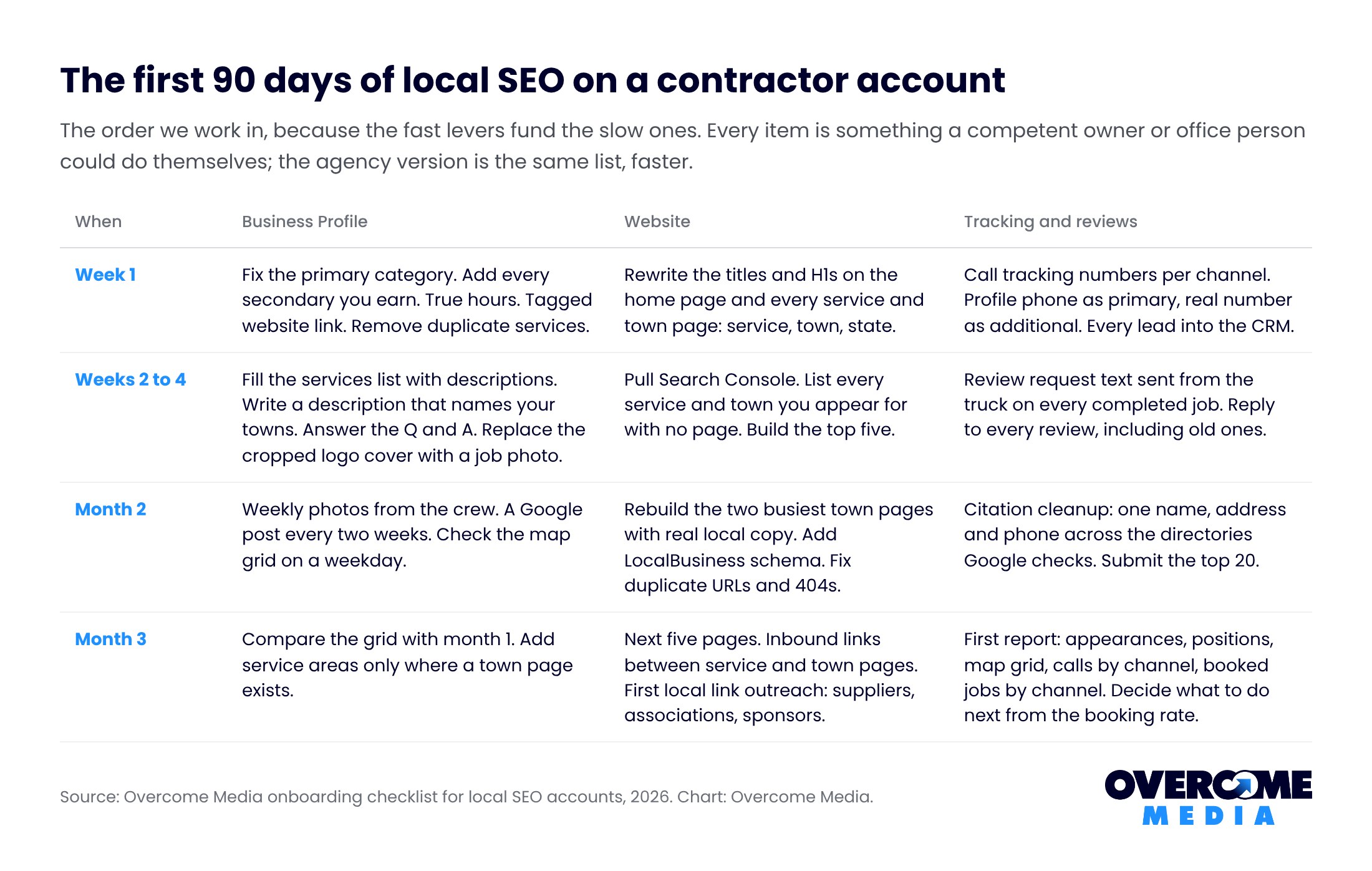
The order matters because the fast levers fund the slow ones.
- Week one: categories, hours, the tagged link, titles and H1s, and tracking numbers.
- Weeks two to four: fill the profile, build the first five missing pages and start the review routine.
- Month two: photos, posts, the two busiest town pages, schema and citations.
- Month three: the next five pages, the first local link outreach, and the first report.
That first report covers appearances, positions, the map grid, calls by channel and booked jobs by channel. From there the booking rate by channel decides what gets built next.
How long does local SEO take for a contractor?
Lever by lever, here is what we have measured.
- A primary category fix in days.
- Title rewrites in two to six weeks.
- New pages appear in week one and settle by week eight.
- Secondary categories and profile fills in one to two months.
- Reviews and citations in three to six months.
- Links in six to twelve.
Judge the whole program at month six and again at month nine. Compare the same season year over year, because a May to June jump in AC searches is weather, not SEO.
The full timeline with the dates we measured is in how long local SEO takes.
What does local SEO for contractors cost?
Most trades businesses that hire an agency pay between $2,000 and $6,000 a month for local SEO. That is as of October 2026. The range depends on how many towns and services are in scope and whether the website needs rebuilding.
Done in house it costs a few hours a week. It takes the discipline to ask for reviews on every job, and one person who owns the profile.
Either way, ask for proof at each stage.
- Proof of shipped work at month one.
- Movement in Search Console and on a map grid at month three.
- Calls up year on year at month six.
How does local SEO differ by trade?
- Roofing SEO: the website half moves fast on title rewrites. The map half is a review velocity race against companies with hundreds of reviews and links. Storm season triples search volume for two weeks.
- HVAC SEO: one category on the profile is the most common gap. A page per system (heat pumps, mini splits, indoor air quality) is the cheapest ranking gain. Cooling pages indexed by March, heating pages by September.
- Junk removal SEO: the primary category decides everything. Listed hours change map reach by the day. People search by the item, so the site needs a page per item.
- Dumpster rental, lawn care, construction: same system. Service area and town pages carry more of the weight for dumpster and lawn companies. Project pages with real photos do the work for builders.
Once the free channels are built, the next question is paid. The Google Ads for contractors guide covers Local Services Ads and search. The leads guides for roofing, HVAC and junk removal rank every channel by what a booked job costs.
Frequently asked questions
What is the most important local SEO factor for a contractor?
For the map, the primary category on the Google Business Profile, then reviews added per month. For the website, page titles that carry the service, town and state, and a page for each service and town. All four are things the business controls.
Is the Google Business Profile more important than the website?
For emergency and near me searches, yes. Those are answered from the map. On one roofing account the profile sent 42 percent of organic clicks on its own.
The website matters for planned work, specific services and towns, and for turning a visitor into a call. Both are needed.
Can a contractor do local SEO without an agency?
Yes. An owner or an office person can do everything in the 90 day plan above. It takes a few hours a week.
The agency version is the same list done faster, with the tracking and reporting built in. The part most owners cannot outsource is asking for reviews on every job.
How many towns can a contractor rank in?
In the map, mostly the towns near the physical location. A profile’s reach shrinks with distance. Google will not show a business as local to a town 40 miles away.
In the website results, any town with its own real page. Service areas on the profile support town pages. They do not replace them.
Does local SEO still work with AI answers in search?
Yes. AI answers for local service searches draw on the same Business Profile data, reviews and pages. The map pack still appears for near me and emergency searches.
The businesses that show up in AI answers have complete profiles, recent reviews and specific pages. That is the same work.
Want to know where your business stands on all three parts?
We will run the same checks we run on day one of a new account, on your profile, your site and your tracking. We will send back what we find with the three things to fix first.
No call required. Request the free SEO audit or call (859) 710-8408.
Overcome Media is a marketing agency in Lexington, Kentucky. We run local SEO for trades businesses across Kentucky, Ohio and the surrounding states. See the industries we work in.
Sources
- How to improve your local ranking on Google, Google Business Profile Help
- Google Search Console, BrightLocal Local Search Grid, live Google Maps and WhatConverts data from Overcome Media roofing, HVAC, junk removal, construction and dumpster rental clients, August to October 2026. Clients and cities withheld.

Written by
Faisal Zaman
Senior SEO Strategist, Overcome Media
Faisal runs SEO for Overcome Media’s roofing, HVAC, junk removal and dumpster rental clients. He builds the Google Business Profile, location page and content plans that get blue collar companies into the map pack, and writes the Knowledge Base from what works on live client accounts.