 OvercomeMedia
A marketing budget for a contractor is best set from the jobs you need, then checked against revenue. Company surveys in 2025 put marketing at 7.7 to 9.4 percent of revenue. Trade advisors often suggest about 10 percent for a contractor who wants to grow.
Key points
- Gartner’s 2025 survey found marketing budgets at 7.7 percent of company revenue.
- The CMO Survey put it at 9.4 percent in spring 2025.
- A percentage is a sanity check, not a plan.
- The plan is jobs needed times the cost of a booked job.
- Fund the free channels and tracking first, then paid ads.
- Judge every dollar on cost per booked job.
The percentage benchmarks come from published surveys, and most of them cover large companies. We say which is which. The channel costs come from our own accounts and from labeled industry benchmarks.
Worked examples use round illustrative numbers. Swap in your own ticket size and booking rate.
In this guide
- Marketing budget as a percentage of revenue
- How to set a budget from the jobs you need
- How to split the budget
- How much a small contractor should spend
- Changing the budget by season
- What wastes a marketing budget
- How to tell if it is working
- Frequently asked questions
What percentage of revenue should a marketing budget be?
Most published numbers land between 7 and 12 percent. But they measure very different companies, so read them with care.
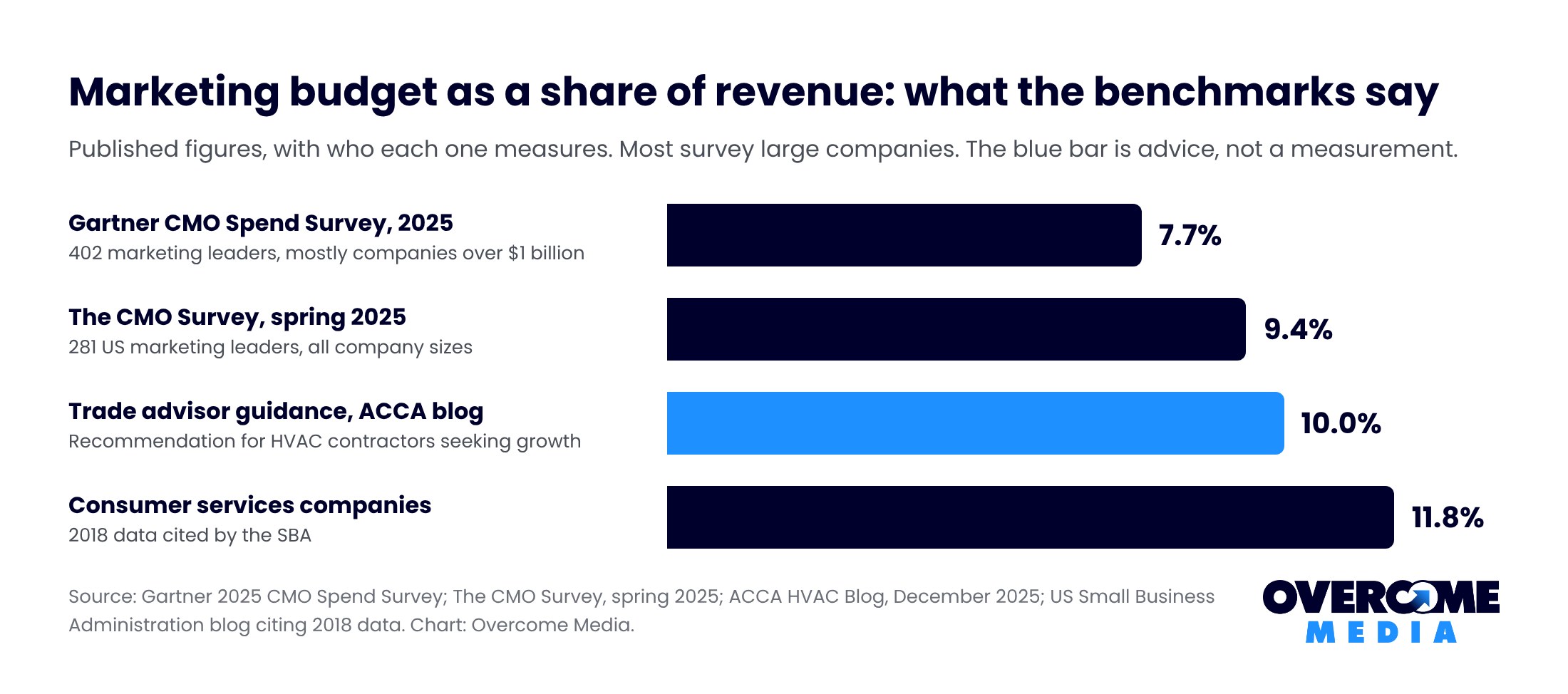
| Benchmark | Share of revenue | Who it measures |
|---|---|---|
| Gartner CMO Spend Survey, 2025 | 7.7% | 402 marketing leaders, mostly at companies over $1 billion |
| The CMO Survey, spring 2025 | 9.4% | 281 US marketing leaders, all sizes |
| Trade advisor guidance, ACCA blog, 2025 | 10% | A recommendation for HVAC contractors seeking growth, not a survey |
| Consumer services, cited by the SBA | 11.8% | 2018 data for business to consumer service companies |
Contractors sell services to homeowners. That puts them closest to the consumer services figure. Older data, but the direction holds.
The trade advice adds one useful twist. Base the percentage on the revenue you want, not the revenue you have. A business planning to grow has to market ahead of the growth.
Use the percentage as a guardrail. If your plan comes out at 25 percent of revenue, something in the plan is off.
How do you set a marketing budget from the jobs you need?
Work backward from the schedule. Every number you need is already in your books or your call log. The steps:
- Pick the extra revenue you want each month.
- Divide by your average ticket to get jobs needed.
- Divide jobs by your booking rate to get leads needed.
- Multiply leads by your cost per lead.
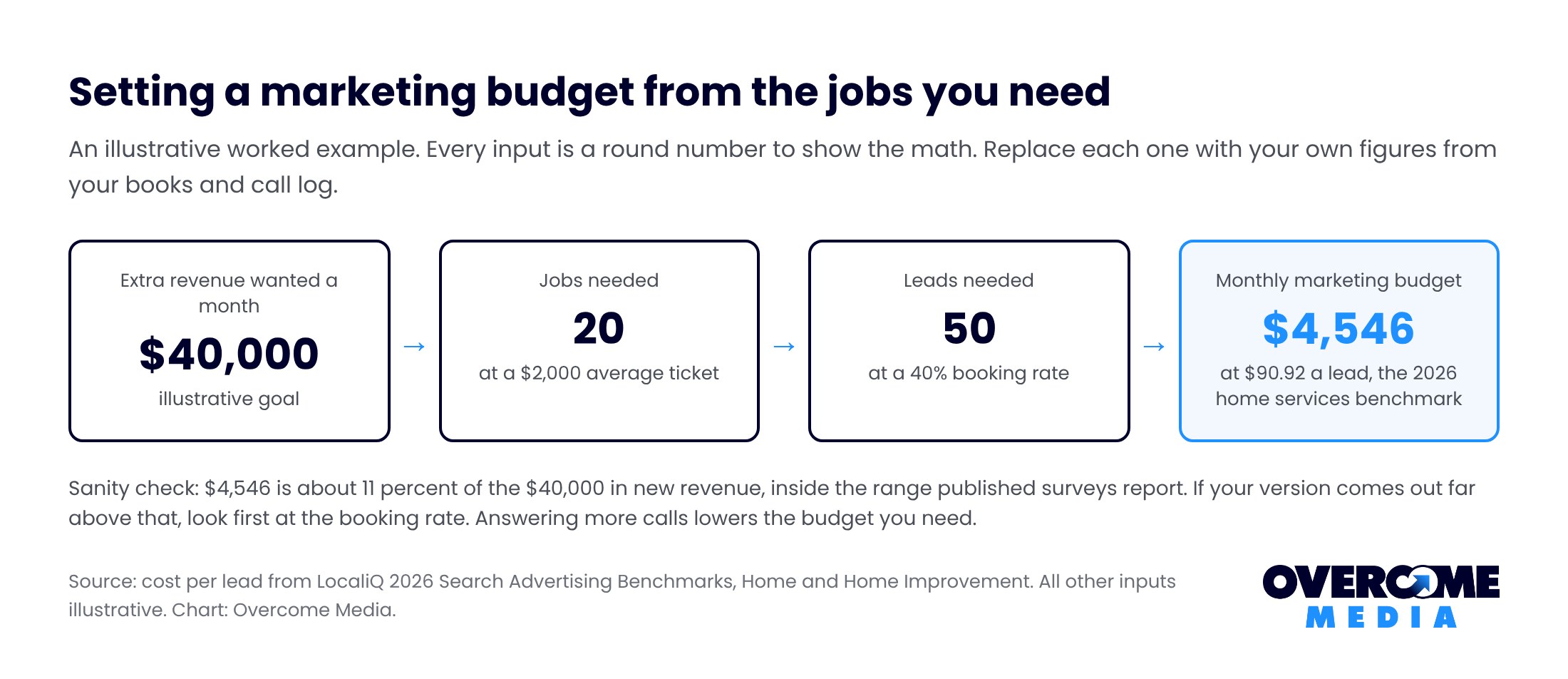
An illustrative example. You want $40,000 more a month. Your average ticket is $2,000, so that is 20 jobs.
You book 40 percent of leads, so you need 50 leads. At the 2026 home services benchmark of $90.92 a lead, that is about $4,546 a month.
That is about 11 percent of the new revenue. It sits inside the published range, so the plan passes the sanity check.
Your cost per lead depends on the trade. Roofing and HVAC clicks cost far more than lawn care clicks. Our Google Ads cost guide has the prices by trade.
Want this done for you? Book a free 15 minute call or call (859) 710-8408. We will tell you what to fix first, no pitch.
How should a contractor split the marketing budget?
By build order, not by equal slices. Some channels cost nothing but time. Others need a foundation in place before they pay.
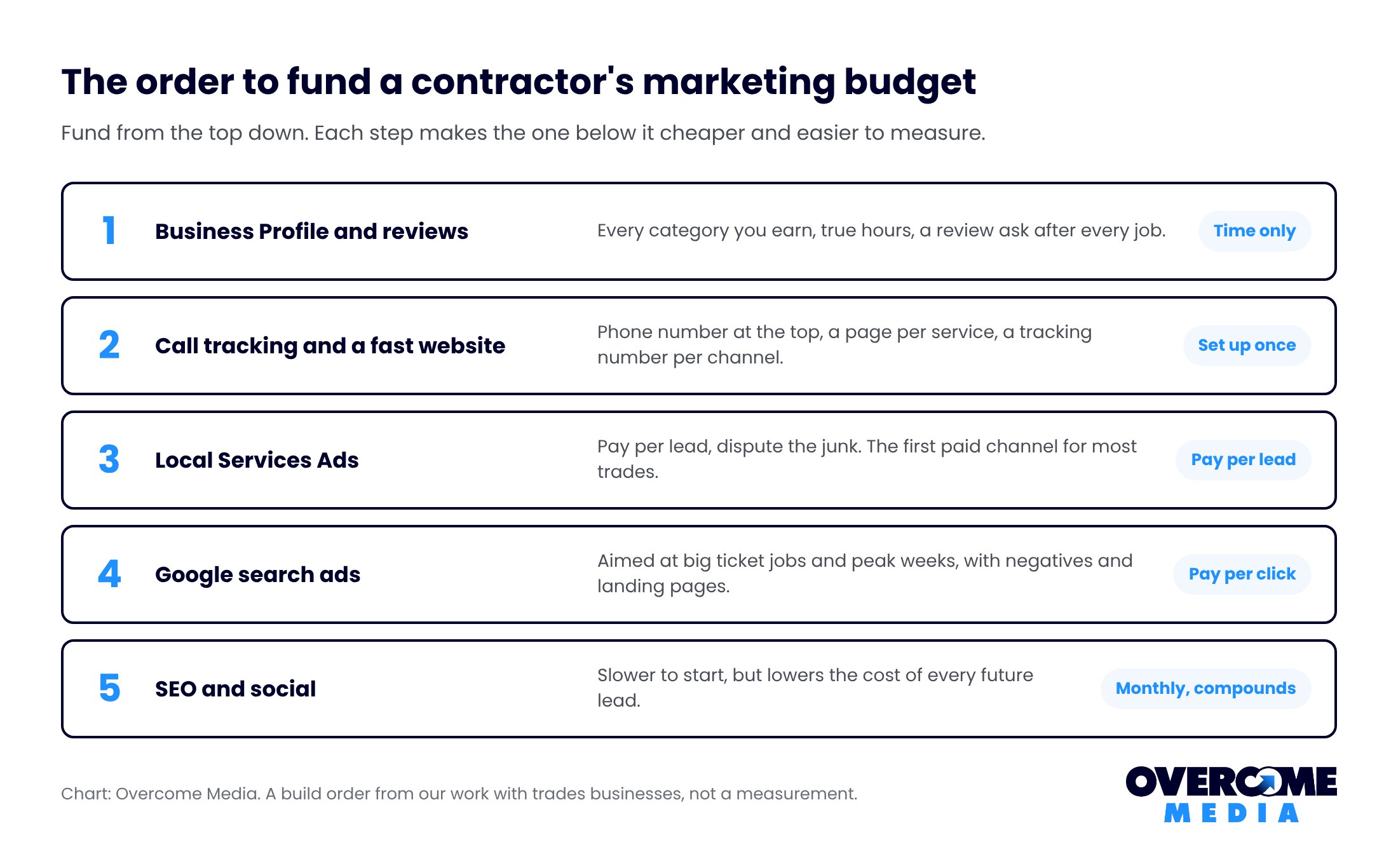
Here is what each line costs, from our accounts and our pricing:
| Budget line | What it costs | Basis |
|---|---|---|
| Google Business Profile and reviews | Time only | Free to run |
| Local Services Ads | $15.09 a lead | Our junk removal account, September 2026 |
| Google search ads | $31.36 per conversion | Our lawn care account, May to June 2026 |
| Google search ads, all home services | $90.92 a lead | LocaliQ benchmark, 2026 |
| Local SEO with an agency | $2,000 to $6,000 a month | Our pricing, October 2026 |
Paid ads bring calls this month and stop when you stop paying. SEO is slower but lowers the cost of every future lead. Our guide on how long local SEO takes sets the timeline.
Lead marketplaces are the last line, if they appear at all. See Thumbtack vs Angi before you fund them.
Full pricing for our services is on the pricing page.
How much should a small contractor spend on marketing?
Less than you fear, if you spend it in order. A new or small business needs more awareness than an established one. The SBA makes that point too.
A small marketing budget for a small business should cover:
- A complete Business Profile with every category you earn.
- A review request sent after every job.
- A simple site with the phone number at the top.
- Call tracking so you know where calls come from.
- Local Services Ads as the first paid channel.
Local Services Ads suit small budgets because you pay per lead. On our junk removal account, 20 charged leads cost $302 in September 2026.
Add search ads once the phone is answered every time. Our contractor leads guide ranks every channel by cost per job.
Should a contractor’s marketing budget change by season?
Yes. Demand in the trades is seasonal, and the budget should follow it. Roofing peaks after storms. HVAC peaks in the first hot and first cold weeks. Lawn care peaks in spring.
The ACCA blog piece suggests putting 60 to 70 percent of spend into a peak window of four to six months. That is a practitioner’s advice, not a study. It fits the seasonal shape of trade demand.
Google Ads helps here. A campaign can spend up to 2 times its daily budget on a busy day. It still cannot bill more than 30.4 times the daily budget in a month.
Do not go dark in the slow months, though. Use them for SEO pages, reviews and the website. Those are ready when the season turns.
What wastes a contractor’s marketing budget?
These leaks are common in the trades. None of them need more money to fix.
- Paying for calls that ring out after hours.
- Ads that send every search to the home page.
- No tracking, so the worst channel never gets cut.
- Buying shared marketplace leads with a slow reply.
- Spending on a logo refresh before the phone number is easy to find.
One of our roofing clients had a Business Profile with zero posts and no cover photo. Yet that profile drove 42 percent of the site’s organic clicks.
Free channels like that deserve attention before the next ad dollar. They cost time, not budget.
The other leak is impatience. Switching channels every month means none of them get enough data to judge. Give each paid channel 60 to 90 days on a fixed budget.
How do you know if your marketing budget is working?
Measure cost per booked job by channel. Cost per click and cost per lead are steps on the way. They do not tell you if the money came back.
You need three things:
- A tracking number per channel.
- A CRM that marks each lead booked or lost.
- A monthly look at spend divided by booked jobs.
Our call tracking guide walks through the setup.
Then check the phone. Invoca’s 2026 home services report found only about 52 percent of callers reach a live person.
A budget that buys calls nobody answers is the most expensive kind. Fix the answer rate before you raise the spend.
Frequently asked questions
How much should a small business spend on marketing?
Published surveys put companies at 7.7 to 9.4 percent of revenue in 2025. Consumer service businesses have historically spent more. For a contractor, set the figure from the jobs you need, then check it lands in that range.
What is a good marketing budget percentage of revenue?
For a contractor aiming to grow, around 10 percent of target revenue is common trade advice. A business holding steady can spend less. A new business usually needs more to get known.
How do you set a marketing budget?
Start with the extra jobs you want a month. Divide by your booking rate to get leads, then multiply by your cost per lead. Check the total against revenue, and adjust each month on cost per booked job.
Does the marketing budget include agency fees?
It should. Count ad spend, agency or staff time, software and tracking together. Otherwise the cost per booked job looks better than it is.
Should I cut marketing when business is slow?
Usually not. The SBA notes that slowing sales are often a reason to market more, not less. Cut the channels with a high cost per booked job, and keep the ones that book.
Want a marketing budget built from your own numbers?
We will look at your profile, your site, your ads and your call log. Then we will tell you what each booked job costs today and where the next dollar should go. Request the free audit or call (859) 710-8408.
Overcome Media is a marketing agency in Lexington, Kentucky. We work with trades businesses across Kentucky, Ohio and the surrounding states. See the Google Ads for contractors guide, or browse our services.
Sources
- Google Ads data from an Overcome Media lawn care client, May 3 to June 29, 2026. Local Services Ads data from an Overcome Media junk removal client, September 2026. Clients and cities withheld.
- Gartner 2025 CMO Spend Survey, May 2025
- The CMO Survey, spring 2025 edition, as reported by CustomerThink
- Smart spending: how to allocate your 2026 marketing budget, ACCA HVAC Blog, December 2025
- How to Get the Most From Your Marketing Budget, US Small Business Administration
- 2026 Search Advertising Benchmarks, LocaliQ
- Manage your spend in Google Ads, Google Ads Help
- The Invoca Home Services Lead Conversion Benchmarks Report, 2026

Written by
Faisal Zaman
Senior SEO Strategist, Overcome Media
Faisal runs SEO for Overcome Media’s roofing, HVAC, junk removal and dumpster rental clients. He builds the Google Business Profile, location page and content plans that get blue collar companies into the map pack, and writes the Knowledge Base from what works on live client accounts.