 OvercomeMedia
Google Maps SEO is the work of getting your Business Profile into the three map results for the searches that book jobs. Google ranks those results on relevance, distance and prominence. You control relevance and prominence. Distance you mostly work around.
Key points
- Your primary category is the top map factor in Whitespark’s 2026 study.
- Three of the top four factors cannot change unless the business moves.
- Business Profile signals carry about a third of the map weight. Reviews carry about a fifth.
- Showing “Closed” costs you rankings during those hours.
- Make one profile change at a time. Big batches cause a temporary dip.
- No pile of reviews beats distance on the far side of your service area.
The ranking factors come from Whitespark’s 2026 Local Search Ranking Factors survey and BrightLocal’s breakdown of it. Google’s own help pages fill in the rules.
The examples come from map grids we track on our own client accounts. Client names and towns are withheld.
In this guide
- How Google picks the map pack
- The top Google Maps ranking factors in 2026
- Categories: where Google Maps SEO starts
- Why you cannot rank everywhere
- Hours and the open now factor
- Keywords in your business name
- Reviews, links and Google Posts
- Frequently asked questions
How does Google decide who ranks in the map pack?
Google names three things on its own help page. Relevance is how well your profile matches the search. Distance is how far you are from the searcher. Prominence is how well known you are.
Google also says there is no way to pay for a better local ranking. Ads sit above the map. They do not lift your place in it.
Experts put weights on those signals. BrightLocal’s breakdown of Whitespark’s 2026 survey splits the map pack like this:
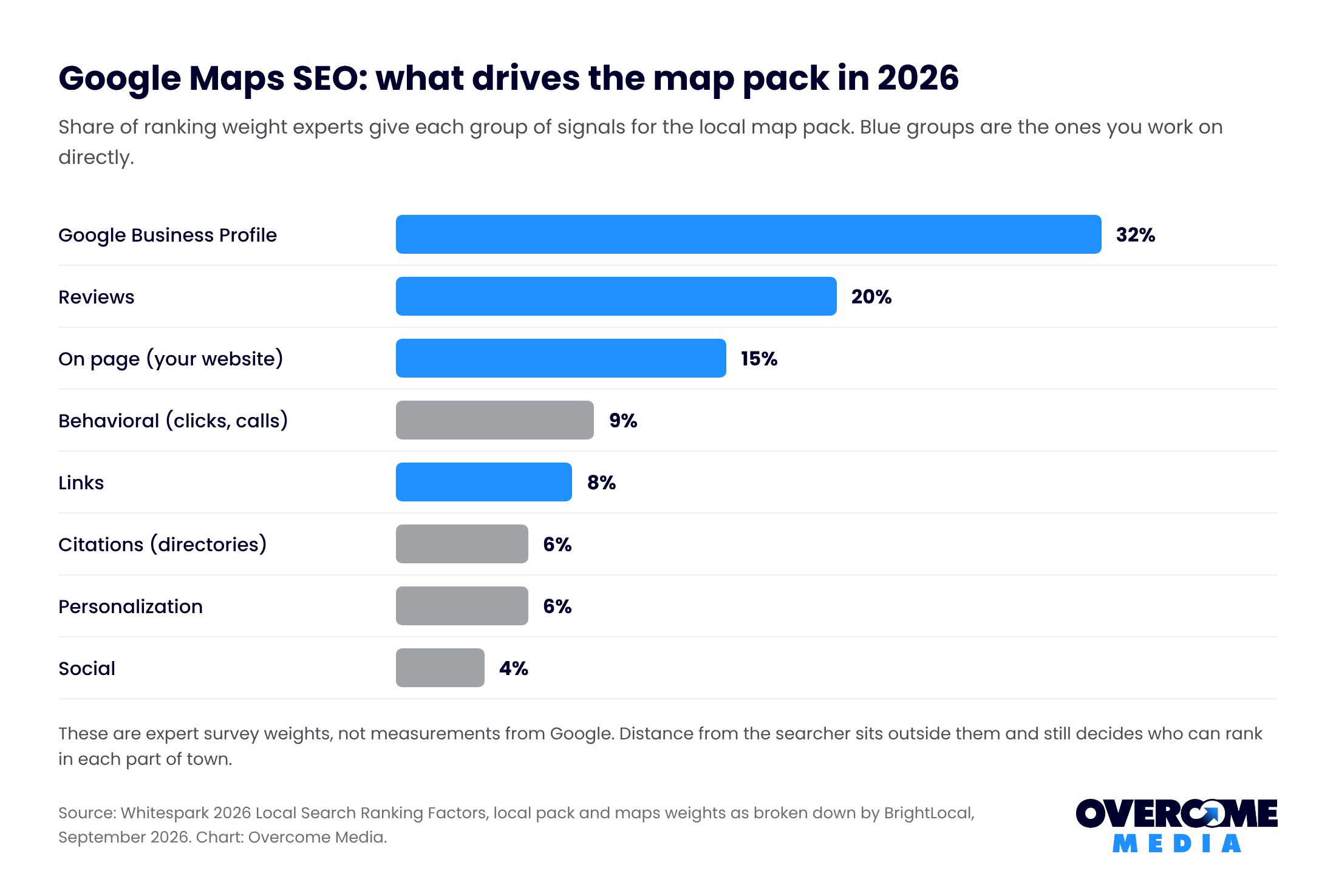
The profile itself is about 32 percent. Reviews are about 20 percent. Together that is more than half the map.
Citations, the directory listings agencies used to sell by the hundred, are down to about 6 percent.
What are the top Google Maps ranking factors in 2026?
Whitespark surveyed 47 local search experts and scored 187 factors. These are the top ten for the map pack, with what you can do about each.
| Rank | Factor | Can you change it? |
|---|---|---|
| 1 | Primary Business Profile category | Yes, today |
| 2 | Distance from the searcher | No |
| 3 | Keywords in the business name | Only by a real rebrand |
| 4 | Physical address in the city searched | Only by moving |
| 5 | Open at the time of search | Yes, if your real hours allow |
| 6 | High star ratings | Yes, over months |
| 7 | Address shown on the profile | Only with a real office customers visit |
| 8 | Additional categories | Yes, today |
| 9 | Number of Google reviews with text | Yes, over months |
| 10 | Map pin placement | Yes, if it is wrong |
Look at the top four. Three of them depend on where the business sits. That is why a new shop across town can outrank an older company for searches near it.
Your work goes into the factors you control. Categories, hours, reviews and the pin come first.
Why does Google Maps SEO start with your categories?
Because the primary category is the number one factor, and it is free to change. It tells Google what you are. A wrong one hides you from the searches you want.
One junk removal client came to us listed as “Garbage collection service”. That is a different business. We switched the primary category to “Junk removal service”.
In the same 36 hours, we added three more categories. We also grew the service areas from 5 to 18.
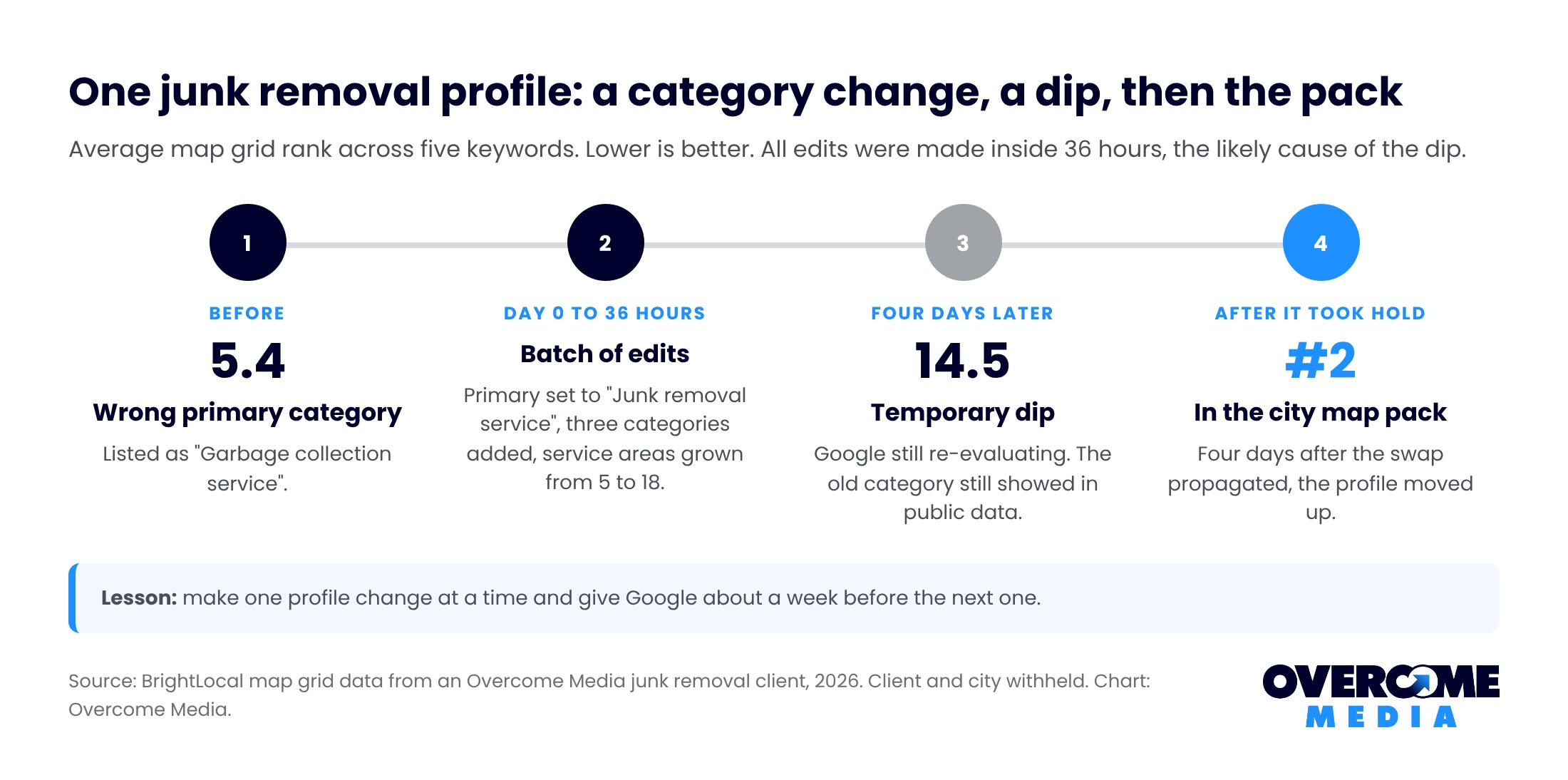
Four days later, the average grid rank across five keywords had gone from 5.4 to 14.5. Lower is better, so that was a drop.
Google was still re-evaluating. The old category even showed in public data. Four days after the swap took hold, the profile reached number two in the city pack.
The lesson: big batches of profile edits cause a temporary dip. Make one change at a time, and wait a week before the next.
For additional categories, add only the ones you earn. Google’s guidelines say to use as few as possible and as specific as possible. A custom home builder we track ranks first on its grid with five categories.
More on junk removal profiles is in our junk removal SEO guide.
Want this done for you? Book a free 15 minute call or call (859) 710-8408. We will tell you what to fix first, no pitch.
Why can’t you rank on Google Maps across your whole service area?
Because distance is a top two factor, and reviews cannot beat it.
One lawn care client of ours has 368 reviews at 4.9 stars. That is more than any independent competitor on its local map. It answered 9 of its 10 newest reviews.
It still ranked first for “lawn care” near its office and 12th downtown. In neighboring towns, it did not show at all.
So map rank is not one number. It changes block by block. That is why we track it on a grid of points, not with one search from the office.
For the towns the map will not reach, use the website:
- A real page per service and per main town, written for that place.
- Your name, address and phone number matching the profile exactly.
- Job photos and reviews from customers in that area.
Those pages rank in the regular results below the map. Our local SEO guide for contractors covers how to build them.
Keep the service area honest too. Google’s guidelines say it should not reach much past about two hours of driving from your base.
Does being open affect your Google Maps ranking?
Yes. “Business is open at time of search” is the number five map factor in 2026. Whitespark lists it as new this year.
We saw it on a junk removal account. The profile showed “Closed” on Sundays.
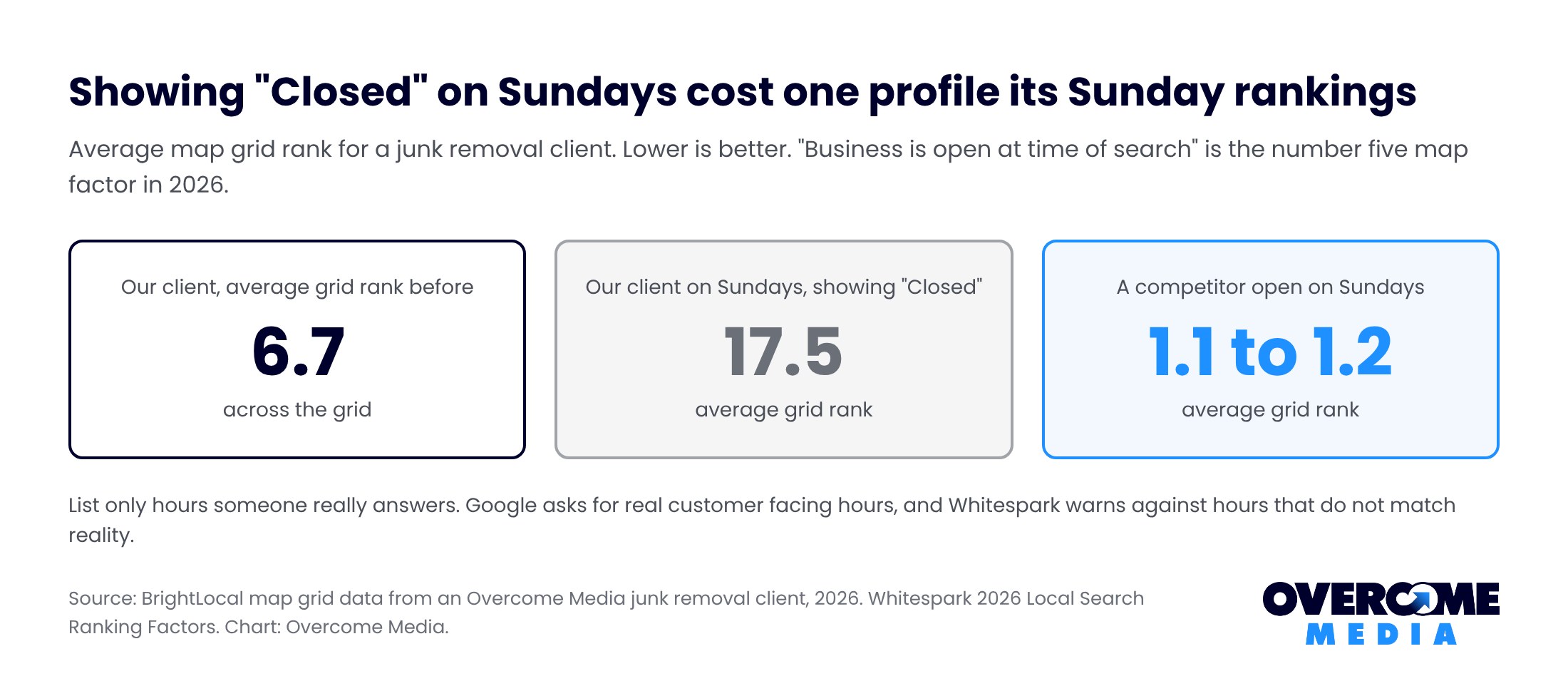
Its Sunday grid rankings collapsed from an average of 6.7 to 17.5. A competitor open on Sundays held 1.1 to 1.2.
Do not fake your hours to win this. Google asks for your real customer facing hours. Whitespark warns against hours that do not match reality.
But if someone really answers the phone on Sundays, list those hours. Many contractors take calls far longer than their profile says.
Answering is what pays off anyway. A ranking on Sunday is worth nothing if the call rings out.
Should you put keywords in your business name?
No, unless they are truly part of your legal or branded name. Keywords in the name rank third in the study. Google’s guidelines still ban adding them.
The rules bar taglines, phone numbers, and location or service details in the name. Breaking them can get the profile suspended.
We learned this on our own profile. A name edit with extra keywords came back “NOT APPROVED”.
Yes, you will see competitors with a town name stuffed in. One did it in a market we watch and ranked on it.
Do not copy it. Anyone can suggest an edit or report it to Google. A rank built on a violation can vanish overnight.
How do reviews, links and Google Posts help you rank higher on Google Maps?
They build prominence, the one part of the formula that keeps growing. Each works on a different clock.
Reviews. Four review factors sit in the top 15. They are high ratings, review count, recency, and a steady flow over time. Pace beats a big old total. Our guide to getting more Google reviews has the full process.
Links. Links weigh about 8 percent for the map. They still separate close calls. One roofing client had 15 referring links against a competitor set of 50 to 1,390.
A competitor that entered that map pack had 68. Local sponsorships, suppliers and trade groups are the realistic sources.
Google Posts. Experts rank posting frequency low, at 148th. Our own data is more interesting.
On one roofing account, the three businesses that newly entered the map pack all published Google Posts. The entrenched top three did not. Treat that as correlation, not proof.
The profile is worth the effort for another reason. That roofing client’s profile drove 42 percent of all organic clicks to its website.
Yet it had zero posts, no cover photo, no booking link and 13 unactioned Google prompts. Each of those is free to fix.
We measured that by tagging the profile’s website link so visits show up as their own source. Our call tracking guide covers the phone side.
Frequently asked questions
How do I get into the Google 3 pack?
Set the most accurate primary category and add the others you earn. Keep true hours, a correct pin and a steady flow of reviews. Then build pages and links that make the business better known. Distance still limits how far from your base you can rank.
How long does Google Maps SEO take?
A category fix can show within days, often after a short dip. Reviews and links take months. Our guide on how long local SEO takes sets out the usual timeline.
Can I pay Google to rank higher on Maps?
No. Google states there is no way to request or pay for a better local ranking. Local Services Ads and search ads appear above the map, but they do not change your organic map position.
Does a service area business rank lower on Google Maps?
It can. “Address is showing” ranks seventh among map factors in 2026. But Google says service area businesses should hide the address. Only show one if customers really visit you there.
How much does Google Maps SEO cost?
The profile work itself costs nothing but time. Done by an agency, it sits inside local SEO, which runs $2,000 to $6,000 a month. See our pricing page for what is included.
Where do you actually rank on the map?
We will run a map grid across your service area and check your categories, hours, pin and reviews. Then we will tell you the one change to make first. Request the free audit or call (859) 710-8408.
Overcome Media is a marketing agency in Lexington, Kentucky. We manage Business Profiles and local SEO for contractors across Kentucky, Ohio and the surrounding states. See our SEO services.
Sources
- Map grid and Business Profile data from Overcome Media client accounts and our own profile, 2026. Clients and cities withheld.
- 2026 Local Search Ranking Factors, Whitespark (47 experts, November 2025)
- Google local algorithm and ranking factors, BrightLocal, updated September 2026
- How to improve your local ranking on Google, Google Business Profile Help
- Guidelines for representing your business on Google, Google Business Profile Help

Written by
Faisal Zaman
Senior SEO Strategist, Overcome Media
Faisal runs SEO for Overcome Media’s roofing, HVAC, junk removal and dumpster rental clients. He builds the Google Business Profile, location page and content plans that get blue collar companies into the map pack, and writes the Knowledge Base from what works on live client accounts.