 OvercomeMedia
Roofing website design has to answer the three worries a roof buyer brings with them. Is this company real, will it handle my insurance claim, and how will I pay for it? A site that answers those with proof, plain claim help and a financing page gets the call.
Key points
- Roofing has two buyers: the leak or storm emergency, and the planned replacement.
- After a storm, buyers are wary of out of town crews, and the FTC tells them to be.
- Your site should show license, insurance and a written estimate before anyone asks.
- A replacement averages about $9,500, so financing belongs on its own page.
- Real job photos and recent reviews do more than any design trend.
We build and fix websites and run SEO for roofing companies. The site findings here come from our own roofing audits in 2026. Names and towns are withheld.
Cost and consumer figures come from Angi, BrightLocal, a 2026 Citizens survey and FTC guidance. Each one is named where it appears.
In this guide
- What roofing buyers need from the site
- Storm damage and insurance claim pages
- Showing financing
- Real job photos and reviews
- The pages a roofing site needs
- Turning visitors into calls
- Frequently asked questions
What does good roofing website design need to do?
Serve two very different buyers on the same site. One has water dripping into a bedroom. The other is pricing a new roof over the next month.
The emergency buyer wants a number and proof you show up. They will not read much.
The planned buyer reads everything. They compare materials, warranties, payment options and photos of past jobs. They may visit three roofers’ sites before calling one.
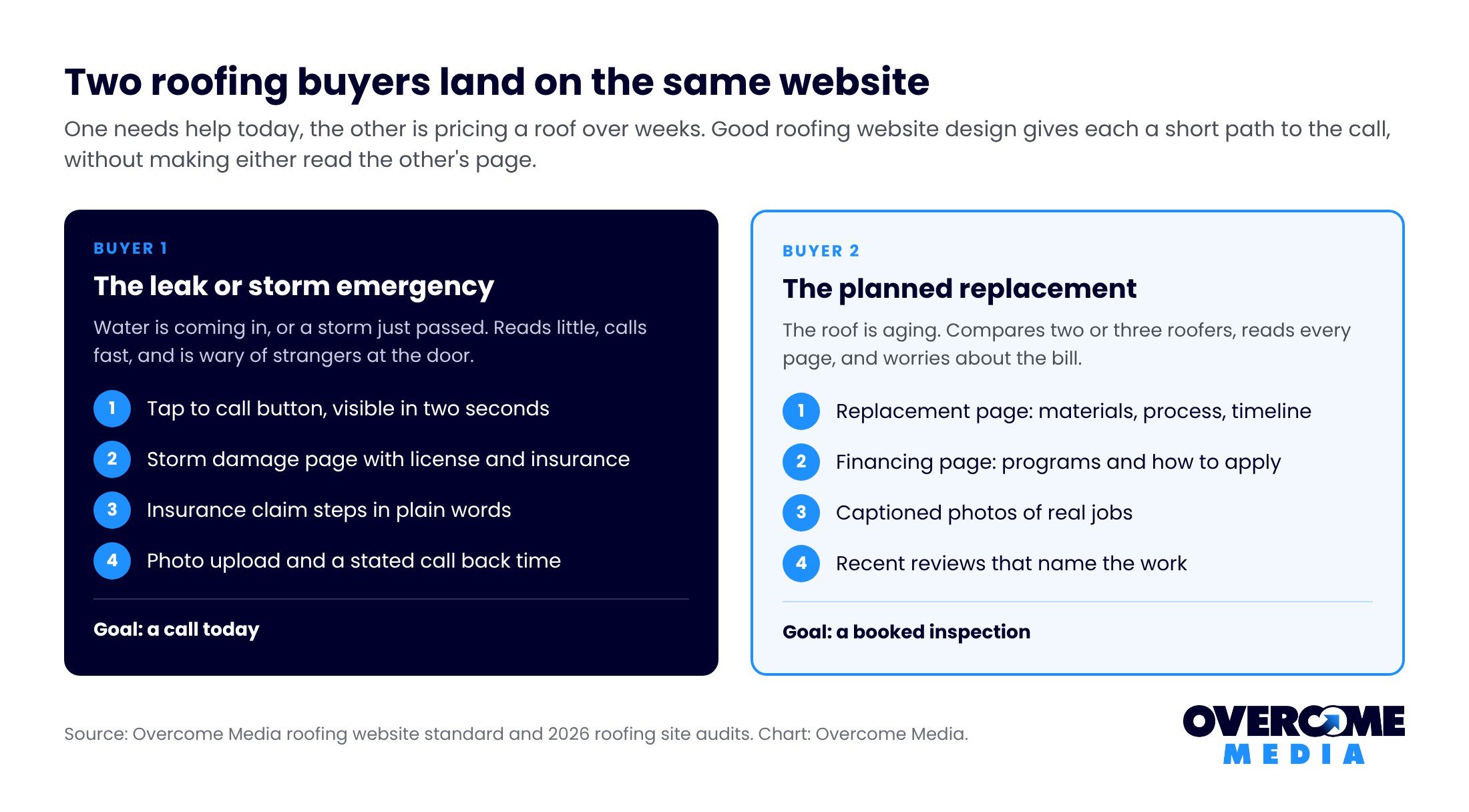
Good design gives each one a short path. The emergency buyer gets a call button and a storm page. The planned buyer gets service pages, a financing page and a gallery.
The rest of the system is the same as any trade. Our contractor website design guide covers structure, speed, tracking and redesigns. This article covers what is specific to roofing. The HVAC website design guide does the same for heating and cooling.
How should a roofing website handle storm damage and insurance claims?
With a storm damage page and an insurance claim page, both live before the storm hits. A page published the week after a hailstorm is weeks late in Google.
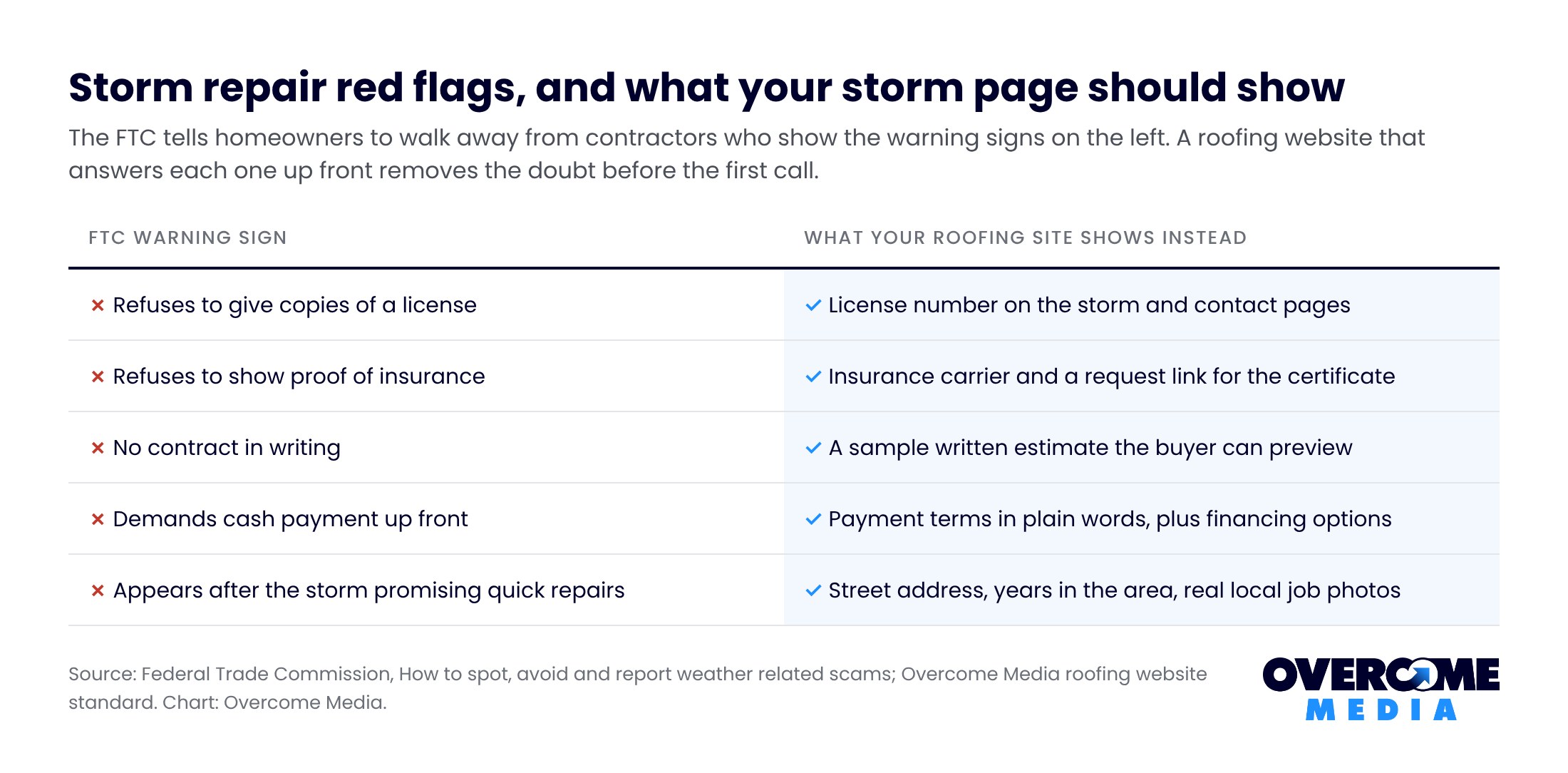
Storm buyers are suspicious, and with reason. The FTC warns that unlicensed contractors and scammers show up in recovery zones promising quick repairs.
Its advice to homeowners is blunt. Walk away from anyone who demands cash up front. Walk away from anyone who will not give copies of their license, insurance and a written contract.
So answer those checks on the page, before the homeowner asks:
- Your license number and proof of insurance.
- Your street address and how long you have worked in the area.
- A sample written estimate, so they know what they will get.
- Your payment terms in plain words.
The insurance page should explain the process from the homeowner’s side. Keep it to steps they can follow:
- Photograph the damage and stop the leak if it is safe.
- Book an inspection and get a written damage report.
- Call the insurer and open the claim.
- Have the roofer meet the adjuster, if the homeowner wants that.
- Review the estimate before any work starts.
Promise only what you control. “We will help you document the damage” is honest. “Get a free roof from insurance” is not, and careful buyers know it.
Want this done for you? Book a free 15 minute call or call (859) 710-8408. We will tell you what to fix first, no pitch.
Should a roofing company website show financing?
Yes, on its own page and linked from every replacement page. A new roof is one of the largest bills a homeowner faces.
Angi puts the national average for a roof replacement at about $9,500. Large or premium roofs run several times that.
Most buyers expect to borrow for this kind of project. A 2026 Citizens survey of 1,077 US adults found 63 percent expect to need financing for a home purchase or improvement within five years.
The same survey found 39 percent do not understand how financing options work. That is the gap your page fills.
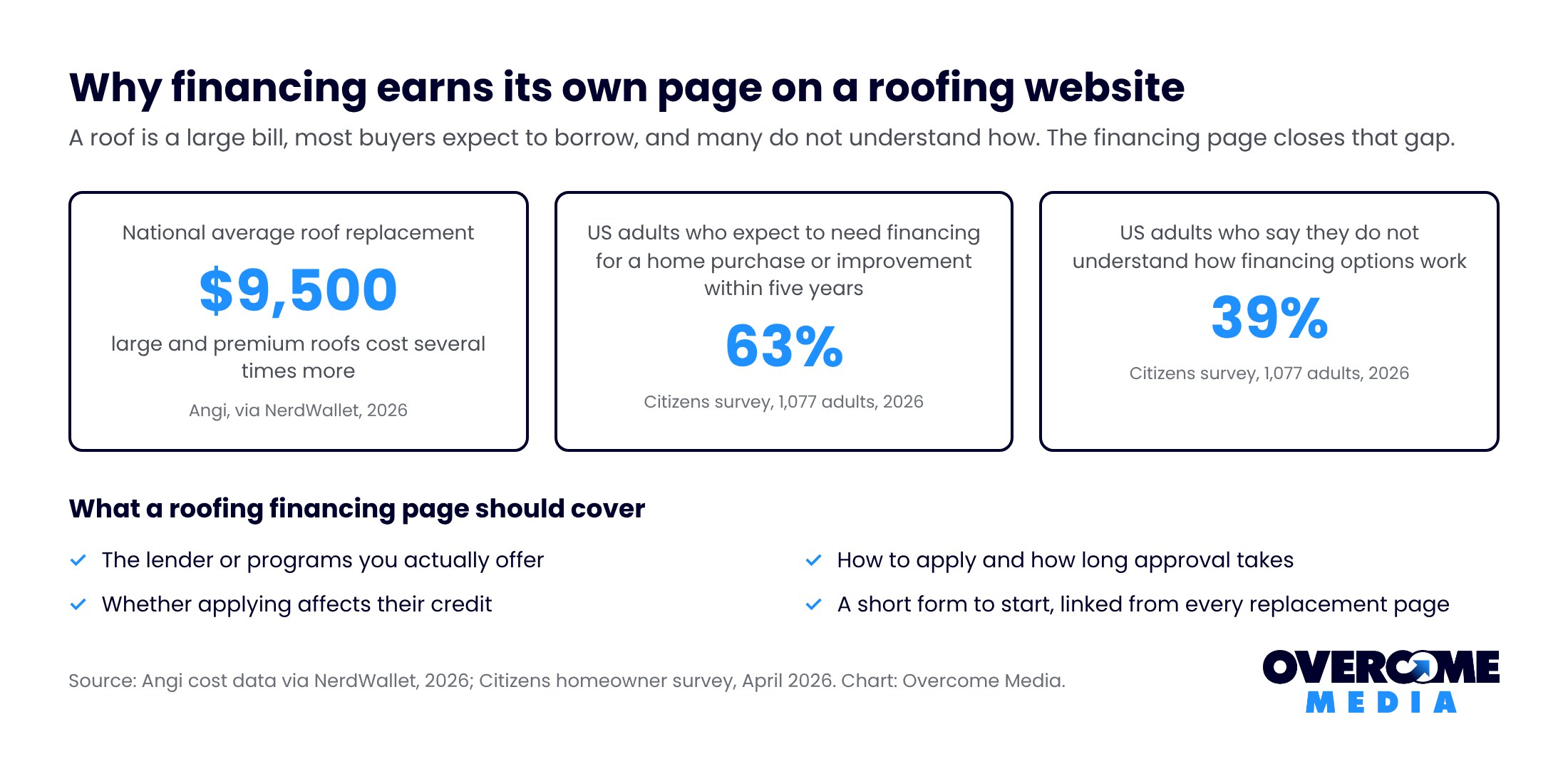
A financing page that helps:
- Names the lender or programs you actually offer.
- Explains how to apply and how long approval takes.
- Says whether applying affects their credit.
- Links to a short form to start.
Have your lender approve the wording before it goes live. Payment and rate claims come with rules, and the lender knows them.
Why do real job photos matter on a roofing company website?
Because a roof buyer cannot see your work up close. Photos are the only proof they get before you arrive.
Stock photos of perfect roofs prove nothing. Buyers have seen the same images on other sites. Your own photos of your own crews do the work instead.
The photos that sell roofs:
- Before and after pairs from the same angle.
- Close ups of flashing, valleys and ridge work.
- Storm damage you found and documented.
- Your crew and trucks on the job site.
Put the photos where the decision happens. A gallery page is fine, but each service page should carry three or four photos of that exact job.
Caption each one with the job type and material. “Full tear off, architectural shingles” tells a buyer more than “Another happy customer”.
Reviews work the same way. BrightLocal’s 2026 consumer survey found 47 percent of people will not use a business with fewer than 20 reviews.
Recency matters too. In the same survey, 74 percent said they only care about reviews from the last three months.
Pull fresh reviews onto the site and keep them current. And ask customers to name the job in their review.
One roofing client we audited had 14 reviews. Google had extracted zero service keywords from them. Competitors averaged about 10 service topics each.
The fix was a new review request that asks customers to mention the work done. Our guide to getting more Google reviews has the wording.
Which pages should a roofing company website have?
One page for each service you sell, plus the pages that answer the three worries. A solid starting set:
| Page | Who it is for | What it must show |
|---|---|---|
| Roof replacement | Planned buyer | Materials, process, timeline, financing link |
| Roof repair | Emergency buyer | Call button, response time, common leaks |
| Storm damage | Storm buyer | License, insurance, inspection booking |
| Insurance claims | Storm buyer | Claim steps, what you do and do not do |
| Financing | Planned buyer | Programs, how to apply, credit impact |
| Metal, gutters, siding | Planned buyer | Only if you sell them, each on its own page |
| Gallery and reviews | Both | Real jobs, captioned, recent reviews |
Check every button on every page. A roofing site we fixed had six service page buttons naming the wrong service. Its siding page pushed metal roofing.
Keep the area pages focused too. On that site, each town page carried a grid of 12 service cards. We cut it to the four services people actually called about.
Each service page is also how you rank. Our roofing SEO guide covers titles, area pages and the map pack.
How do you turn roofing website visitors into calls?
Make calling easy, make the form useful, and answer fast. Here is our test. A homeowner with a leak should find your number in under two seconds.
- Pin a call button to the bottom of the phone screen.
- Offer a “book a free inspection” form for the planned buyer.
- Let them upload a photo of the damage.
- Tell them when you will call back, in the form’s thank you message.
Then answer. Storm weeks bring call spikes, and a missed call is a roof someone else replaces. Our speed to lead guide has the text back and call back sequence.
Track where calls come from. On one roofing account, the Business Profile drove 42 percent of organic clicks to the site. A tagged link showed it.
The rest of the lead picture, from Local Services Ads to door knocking, is in our roofing leads guide.
Frequently asked questions
What should a roofing company website include?
A page per service, a storm damage page, an insurance claim page and a financing page. Add a captioned gallery of real jobs and recent reviews. Show your license and insurance, and keep a call button on every page.
How much does a roofing website cost?
It depends on how many service and area pages you need and who writes the copy. A small template site costs far less than a full build with tracking. Our pricing page explains how we scope it.
Should roofers put prices on their website?
A price range helps the planned buyer, and it filters out people who are not ready. Exact prices rarely work because every roof differs. Explain what drives the price and offer an inspection to firm it up.
Do roofers need a separate storm damage page?
Yes. Storm searches are their own searches, and the buyer has different worries. Publish it well before storm season so Google has time to find and rank it.
What makes a roofing website trustworthy?
Proof you can check. That means license and insurance details, a street address, real job photos and recent reviews. Keep the same phone number and facts everywhere, from the site to the Business Profile.
Is your roofing website losing storm calls?
We will check your storm, insurance and financing pages, your photos, your phone links and your tracking. Then we will tell you what to fix before the next storm. Request the free audit or call (859) 710-8408.
Overcome Media is a marketing agency in Lexington, Kentucky. We work with roofing companies across Kentucky, Ohio and the surrounding states. See what we do for roofing companies and our website design service.
Sources
- Overcome Media website, review and Business Profile audits of roofing client and prospect sites, 2026. Clients and cities withheld.
- How to spot, avoid and report weather related scams, Federal Trade Commission
- Roof replacement cost, NerdWallet, citing Angi cost data, 2026
- Citizens homeowner financing survey, Citizens, April 2026
- Local Consumer Review Survey 2026, BrightLocal

Written by
Faisal Zaman
Senior SEO Strategist, Overcome Media
Faisal runs SEO for Overcome Media’s roofing, HVAC, junk removal and dumpster rental clients. He builds the Google Business Profile, location page and content plans that get blue collar companies into the map pack, and writes the Knowledge Base from what works on live client accounts.