 OvercomeMedia
Good contractor website design turns searches into booked jobs. It needs a page per service, fast phone load times, a number you can tap in two seconds, and tracking on every call. Most sites we audit fail on structure and tracking, not looks.
Key points
- Google ranks pages, so every service you sell needs its own page.
- About half of US web traffic now comes from phones.
- Google’s speed target is a main image or headline on screen within 2.5 seconds.
- The phone number and the form decide whether a visit becomes a lead.
- Without call tracking you cannot tell which page or ad paid for a job.
- A redesign that skips redirects can throw away years of rankings.
We build and fix websites for trades businesses. The site examples here come from our own audits of client and prospect sites in 2026. Names and towns are withheld.
The outside figures come from Google’s own documentation and named industry studies. Where a number is a benchmark, we say so.
In this guide
- What good contractor website design includes
- How to structure a contractor website
- How fast the site needs to load
- Where the phone number and forms go
- How to track calls and forms
- Service pages and location pages
- Redesigning without losing traffic
- What each trade needs from its site
- Frequently asked questions
What does good contractor website design include?
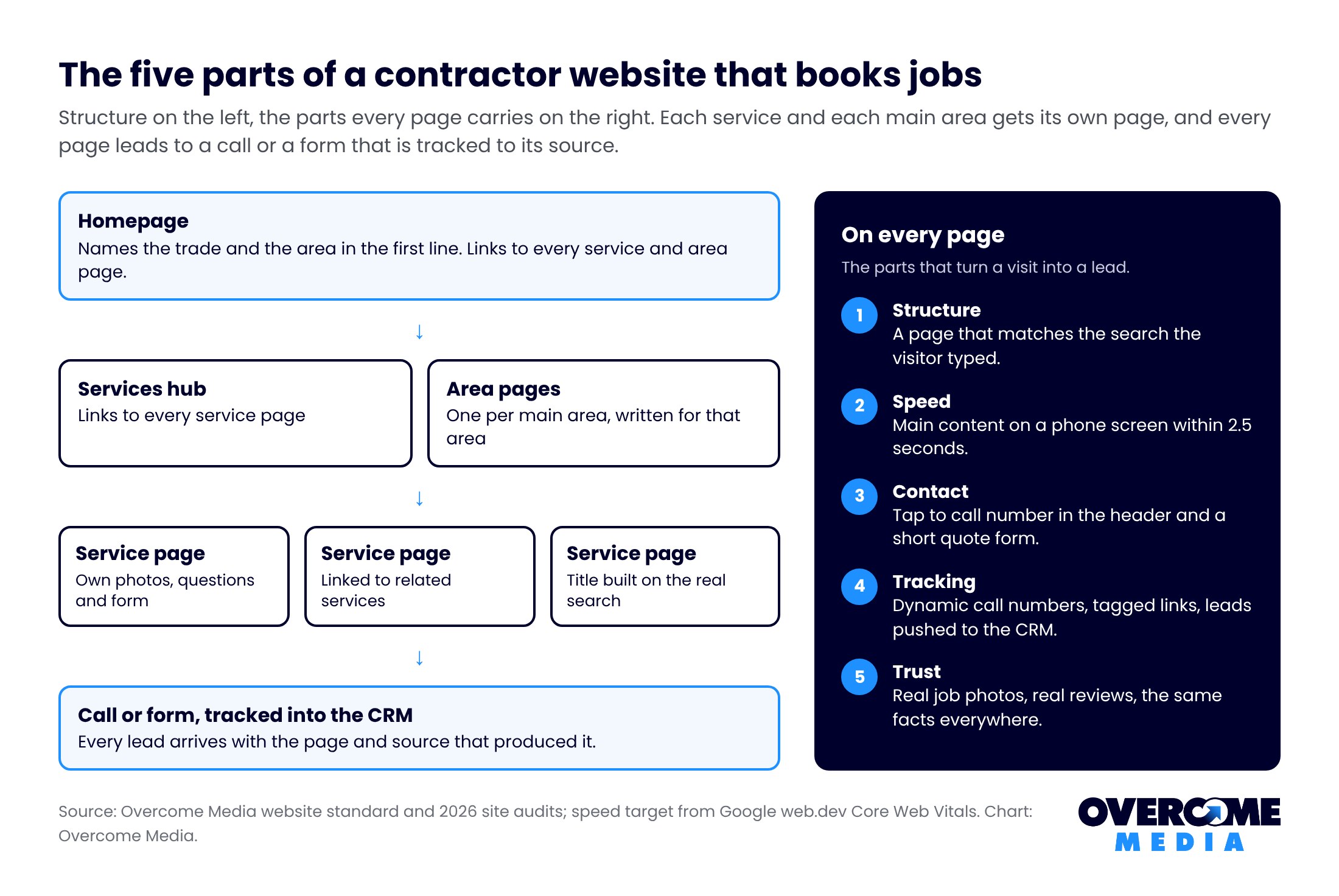
Five parts, and they work as one machine. If one breaks, the others leak.
- Structure. A page for every service and the main areas you work in.
- Speed. Pages that load fast on a phone over a weak signal.
- Contact. A tap to call number and a short form on every page.
- Tracking. Every call and form tied to the page and source that produced it.
- Trust. Real job photos, real reviews and the same facts everywhere.
Looks matter less than most owners think. Homeowners forgive a plain design. They do not forgive a number they cannot find or a form that goes nowhere.
Your site also gets visitors who have already decided to check you out. BrightLocal’s 2026 consumer survey found 54 percent of people visit a business’s website after reading positive reviews.
That visit is the last step before the call. The site’s job is to not lose it.
| What the site must do | What we found on real sites | The fix |
|---|---|---|
| Rank for each service | The homepage took 8,600 of 8,620 monthly visits from Google | One linked page per service |
| Load fast | A 5.62 MB logo file and a 4.5 second full load | Compress images, cut scripts |
| Get the call | A tel: link with a hidden character some phones will not dial | Test the number on real phones |
| Capture forms | Six quote buttons and zero forms on the whole site | A short form on every service page |
| Prove the source | A profile link through two redirects with no tracking tag | Tagged links and call tracking |
| Keep trust | Three different review counts in three places | One set of facts, kept current |
How should a contractor website be structured?
One page per service, linked from the menu and from each other. That is the whole rule, and most sites break it.
On one lawn care site we audited, the homepage took 8,600 of the 8,620 visits Google sent each month. The other 28 pages shared 20 visits.
The odd part is that good pages existed. Six detailed service pages ran 672 to 1,044 words, each with a quote form.
Nothing linked to them. Zero internal links, zero rankings. The menu pointed at thin versions instead, nine of them under 150 words.
Google finds and weighs pages through links. A page nobody links to is a page Google treats as unimportant.
The opposite mistake is cloning. A junk removal site we took over had 16 service pages built from one template. Eleven of the 16 ranked for nothing. The homepage held 44 of the site’s 58 ranking keywords.
We replaced them with ten distinct pages, each written for one job. Those pages earned 681 impressions in their first four weeks.
A structure that works for most trades:
- A homepage that names the trade and the area in the first line.
- A services hub that links to every service page.
- One page per service, each with its own photos, questions and form.
- A page for each main area you serve, written for that area.
- About, reviews and contact pages that every page links to.
Keep the menu short and the links inside the copy generous. A visitor on a roof repair page should be one tap from the gutter page.
How fast does a contractor website need to load?
Fast enough to pass Google’s Core Web Vitals on a phone. Google publishes three targets, measured on the slower visits, not the average.
- Largest Contentful Paint: the main image or headline shows within 2.5 seconds.
- Interaction to Next Paint: a tap gets a response within 200 milliseconds.
- Cumulative Layout Shift: the page moves no more than 0.1 while loading.
Google judges these at the 75th percentile of real visits. So your slowest quarter of visitors decides whether you pass.
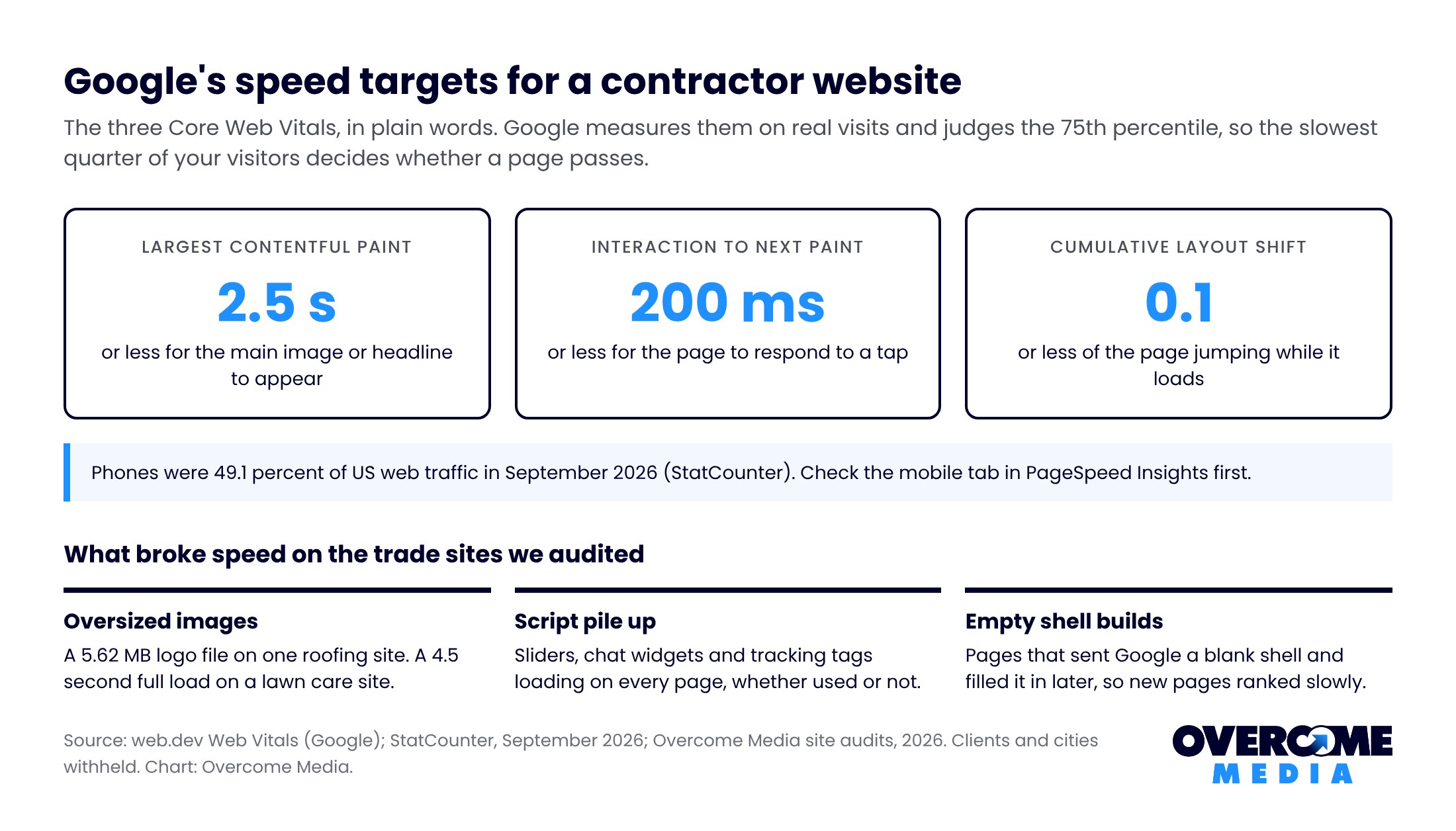
Phones matter more every year. StatCounter put mobile at 49.1 percent of US web traffic in September 2026. Desktop was 48.5 percent.
Treat the phone version as the real site. Design it first and check it first.
What slowed the trade sites we audited was rarely the hosting. It was:
- Oversized images, including a 5.62 MB logo file on one roofing site.
- Sliders, chat widgets and tracking scripts stacked on every page.
- A build that sent Google an empty shell and filled it in later.
That last one is the quiet killer. The page looked fine to a person. Google saw an empty page first, so new pages ranked slowly.
Test any page free in Google’s PageSpeed Insights. Look at the mobile tab and the field data, not the desktop score.
Want this done for you? Book a free 15 minute call or call (859) 710-8408. We will tell you what to fix first, no pitch.
Where should the phone number and forms go on a contractor website?
Our standard is simple. Someone with a leaking roof should be able to find the phone number in under two seconds.
That means a tap to call number in the header of every page, and it stays on screen while they scroll. On a phone, a call button pinned to the bottom of the screen works well.
Then test it. On one lawn care site, the header number held a hidden non breaking hyphen inside the tel: link. It looked normal. Some phones would not dial it.
Forms fail in quieter ways. One fencing and painting prospect had six “Get Your Free Quote” buttons. All six landed on a 230 word contact page with no form on it.
There were zero form elements on the entire site. Every visitor who wanted to type instead of call had nowhere to go.
Buttons can also lie. A roofing site we fixed had six service page buttons labeled with the wrong service. The siding page asked visitors to click “I Want Metal Roofing”.
How many form fields? Fewer is usually better, but not always. In a test reported by CXL, cutting a form from nine fields to six lowered conversions by 14 percent. Rewording the labels raised them instead.
The lesson is to ask only what you need to quote:
- Name and phone number.
- The service, as a dropdown.
- The address or town.
- A short “what is going on” box, plus an optional photo upload.
Put that form on every service page, not just the contact page. And make the confirmation say when you will call back.
How do you track calls and forms from a contractor website?
With call tracking numbers that swap by source, tagged links, and a CRM that receives every lead. Without them, you are guessing which page or ad paid for the job.
Start with the Business Profile link. On one roofing account, the profile drove 42 percent of all organic clicks to the website. We only knew because the link carried a tracking tag.
On another home services site, the profile linked to an old http www address. It bounced through two redirects and carried no tag. Every one of those visits looked like it came from nowhere.
The tracking setup we use:
- A tracking tag on the Business Profile website link.
- Dynamic numbers that show a different number to ad, map and organic visitors.
- Your main number kept on public profiles and in the site’s code for Google.
- Every form and call pushed into the CRM with its source.
Our call tracking guide covers the setup in detail. If you are choosing where those leads land, see our GoHighLevel vs Jobber vs Housecall Pro comparison.
Tracking also shows you the leak after the click. Invoca’s July 2026 home services benchmarks found only about 52 percent of callers reach a live person.
And CallRail’s 2025 survey found 82 percent of people would call a competitor after an unanswered call. A great site cannot fix a phone that rings out.
Pair the site with a fast follow up. Our speed to lead guide has the text back and call back sequence.
Do contractors need service pages and location pages?
Yes, both. People search for the job and often the town. Google needs a page that matches each search.
On one HVAC site, Search Console showed demand with no page to land on:
- Heat pump searches, 114 impressions.
- Humidifier searches, 79 impressions.
- Water heater searches, 46 impressions.
None of those services had a page. Each one is now a page to build.
The lawn care site from earlier had no location pages at all. Yet we found 29 town plus service searches worth 1,120 searches a month. Their keyword difficulty ran from 5 to 19, which is low.
Location pages come with a warning. Google’s spam policies name “doorway abuse”. One example is pages targeted at specific cities that all funnel visitors to one page.
Swapping the town name in a template is exactly that. A real location page has:
- Jobs you have done in that area, with photos.
- Local details that matter to the work, like soil, housing age or permits.
- Reviews from customers there.
- The services you actually offer there, not a grid of everything.
On one roofing site, town pages showed a 12 card service grid. We trimmed it to the four core services. We also rewrote 33 meta descriptions that still held template copy from a site in another state.
Titles matter too. On one custom home builder site, 15 of 28 pages had titles that were taglines or county names. Nobody searches those.
The demand sat in service terms. Pole barn builders had 8,100 searches a month. Land clearing had 1,900 at a keyword difficulty of 2.
Write each title around the search, and claim only what is true. We left out “licensed” and “warranty” on that site because the site never claimed them.
This is where design meets SEO. Our local SEO guide for contractors covers the ranking side.
How do you redesign a contractor website without losing traffic?
Map every old URL to a new one before launch, and redirect each one permanently. Skip this and a new site can rank worse than the ugly one it replaced.
Google remembers old pages for a long time. On one lawn care site, all 26 old town URLs returned errors. Yet 21 of them still earned 1,447 impressions in search.
Every one of those impressions was a click that landed on an error page.
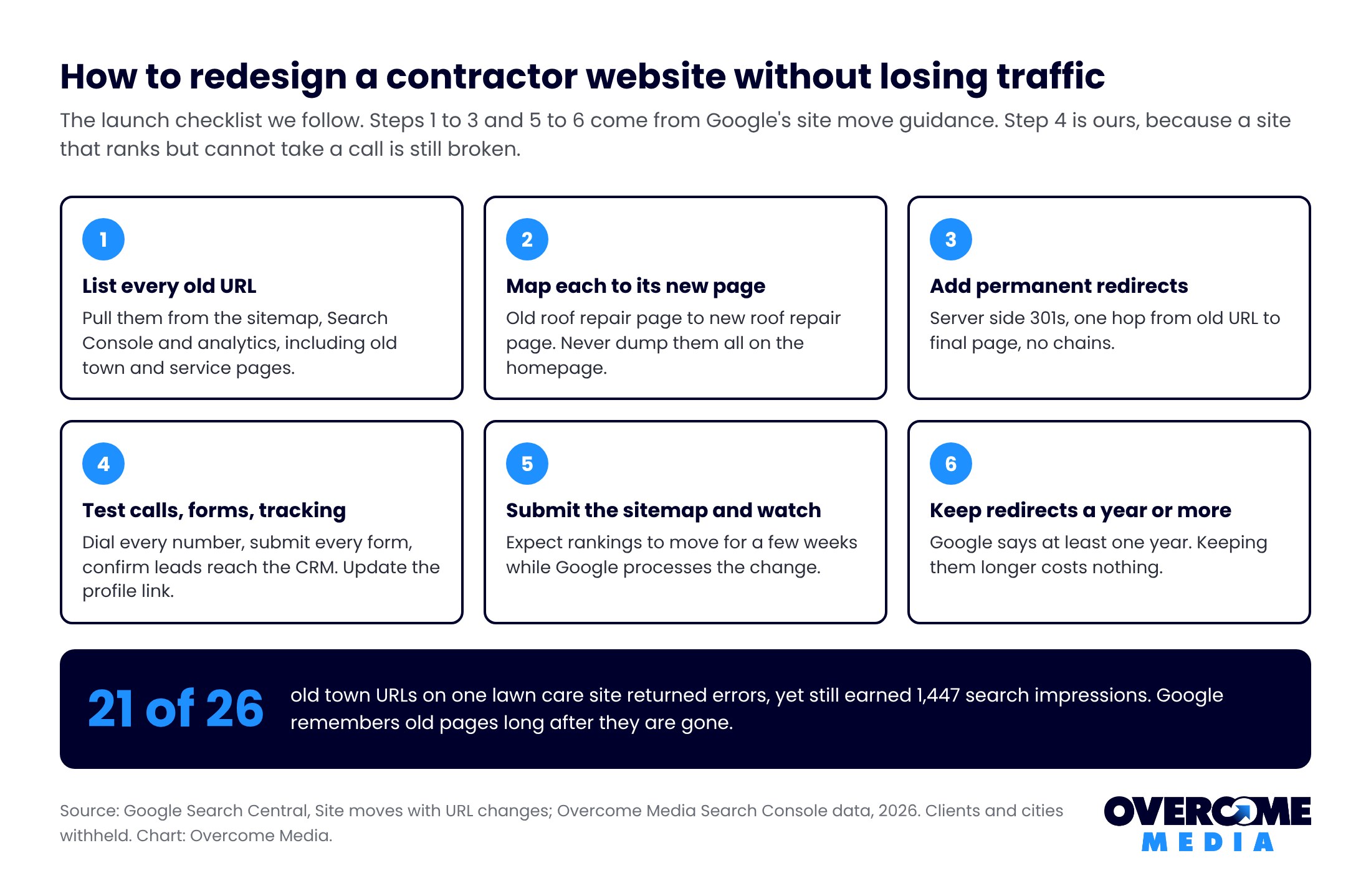
Google’s site move documentation is clear on the basics:
- Map old URLs to new URLs before you start.
- Use server side permanent redirects, like 301s.
- Send each old URL straight to its final page, with no chains.
- Do not send many old pages to the homepage.
- Keep the redirects for at least a year.
Google also says to expect rankings to move around during the switch. For a mid sized site, that can take weeks before things settle.
Our own launch list adds three checks Google does not mention:
- Call every number and submit every form on the live site.
- Confirm the tracking scripts and CRM hookups survived the move.
- Update the Business Profile link and its tracking tag.
Keep what already ranks. Before rewriting any page, check which searches it earns impressions for. On one roofing site we rewrote titles on 36 pages to lead with the searches each page already earned.
What does each trade need from its contractor website?
The system above is the same for every trade. What changes is what the buyer is worried about when they land.
- Roofing. Storm damage, insurance claims, financing and proof of real roofs. See roofing website design.
- HVAC. Emergency calls, maintenance plans and a page per system. See HVAC website design.
- Construction. Project galleries, process and the pages that win bids. See construction website design.
Every trade shares one trust rule. Keep the facts the same everywhere.
One lawn care site quoted three different review counts in three places. None matched the 368 on Google. A visitor who notices starts wondering what else is off.
Use your own photos too. Stock photos of smiling models in clean hard hats tell a homeowner nothing about you. A real crew on a real job does.
Frequently asked questions
What should a contractor website include?
A page for each service and main area, a tap to call number on every page, and a short quote form. Add real job photos, reviews and call tracking. Make sure it loads fast on a phone.
How much does a contractor website cost?
It depends on page count, copy and tracking. A five page template costs far less than a 40 page site with service and location pages. See our pricing page for how we scope it.
If you add ongoing local SEO, most trades businesses we work with pay $2,000 to $6,000 a month for it as of October 2026.
Is a website builder good enough for a contractor website?
It can be, if it lets you build separate service pages, add forms and install tracking. The platform matters less than the structure. Test its mobile speed in PageSpeed Insights before you commit.
How many pages should a contractor website have?
One for every service you want to rank for, plus one for each main area you serve. Add home, about, reviews and contact. A roofer with eight services and six towns needs about 18 pages, each written for its own job.
Will a new website hurt my Google rankings?
Not if every old URL redirects to its matching new page. Google says to expect some movement while it processes the change. Rankings drop for good when old pages vanish without redirects.
Is your contractor website losing calls?
We will check your site’s pages, speed, phone links, forms and tracking. Then we will tell you what is costing you calls and what to fix first. Request the free audit or call (859) 710-8408.
Overcome Media is a marketing agency in Lexington, Kentucky. We build websites for trades businesses across Kentucky, Ohio and the surrounding states. See our website design service.
Sources
- Overcome Media website audits of client and prospect sites (lawn care, roofing, HVAC, junk removal, fencing, custom home building), Search Console and crawl data, 2026. Clients and cities withheld.
- Web Vitals, web.dev (Google)
- Site moves with URL changes, Google Search Central
- Spam policies for Google web search, Google Search Central
- Desktop vs mobile vs tablet market share, United States, StatCounter, September 2026
- Local Consumer Review Survey 2026, BrightLocal
- Should you really reduce form fields?, CXL
- Invoca Home Services Lead Conversion Benchmarks Report, July 2026; CallRail consumer survey, 2025

Written by
Faisal Zaman
Senior SEO Strategist, Overcome Media
Faisal runs SEO for Overcome Media’s roofing, HVAC, junk removal and dumpster rental clients. He builds the Google Business Profile, location page and content plans that get blue collar companies into the map pack, and writes the Knowledge Base from what works on live client accounts.